Rédaction Africa Links 24 with Alix-Ida Mussavu
Published on 2024-03-26 08:18:57
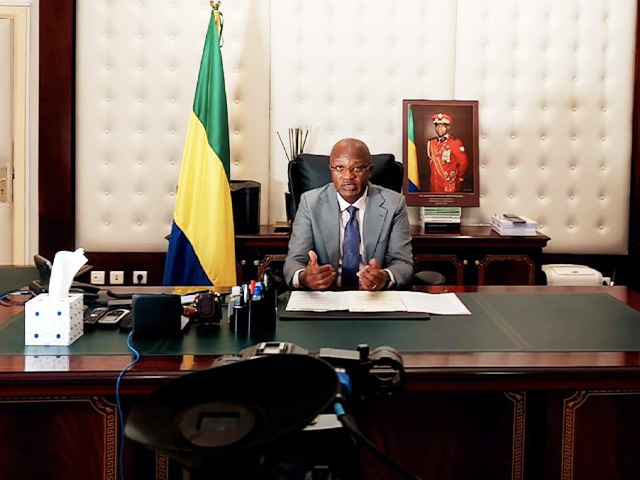
Following the publication of the press release by the United Nations Subcommittee on Prevention of Torture (SPT) after its second visit to Gabon, the Minister of Justice spoke to the press. Responding to various questions related to the prison system, the Minister assured that Gabon had accepted the SPT to come to the country and make its own assessment. “We have nothing to hide in Gabon and in the eyes of the world,” said Paul-Marie Gondjout. Below is the full interview in which GabonReview participated on March 20, 2024.
Journalists: Minister, any comments after the second visit of the United Nations Subcommittee on Prevention of Torture (SPT) to Gabon?
Paul-Marie Gondjout: The United Nations Subcommittee on Prevention of Torture has concluded its second visit to Gabon. A visit that allowed them to visit 18 detention centers (prisons, police stations, the psychiatric hospital of Melen) to see under what conditions persons deprived of their liberty are detained. One of the findings is that there is prison overcrowding. We are not surprised by this because since we took on this role, we have often talked about prison overcrowding and it is a problem that we have taken on. The Transition President had decided at the end of 2023 to grant amnesty to 1,000 prisoners. This was done to alleviate prison overcrowding, but other actions are planned. The issue of prison overcrowding is especially for detainees. That is, people who have been incarcerated for several years and are awaiting trial because their cases have not yet been heard. This poses a problem for us. We had a strike by magistrates for 10 months, but that is not the main cause. The number of people sent to prison is often much higher than it should be. So if there is no criminal session, people are kept in prison. This results in overcrowded wards. This is not worthy of a country like Gabon. Obviously, we accepted that the torture subcommittee come to Gabon and assess the situation. We have nothing to hide in Gabon and in the eyes of the world.
What is the situation of the prison population?
In general, we have between 5,500 and 5,700 detainees in all the prisons in Gabon. Libreville accounts for 65 to 70% of these detainees. Potentially more than 3,000 prisoners in Libreville.
What about the measure of the Transition President on presidential pardon?
It has been implemented. There is a decree that sets the conditions for this presidential pardon because if the president pardons, it must be regulated by the law. Someone who has committed a homicide theoretically cannot benefit from a presidential pardon. At least, they may be eligible for a reduction of sentence, but not for release from prison. We mainly consider people who have committed less serious offenses to be released from prison. For example, there was the president’s speech in Ndendé on man-wildlife conflict. He asked that people incarcerated in this context be released from prison. The Ministry of Justice issued a statement to clarify the President’s statements, who mentioned a certain number of people, but not poachers who kill elephants for the sale of ivory. These individuals, the law is clear: they cannot benefit from presidential pardon.
So 1,000 people are out?
No. In this pardon, there are those who benefit from a reduction of sentence and those who will be released. But there is a whole procedure. The president’s decree is signed, the list of convicts is ready. In the coming days you will know them.
Do you have a strategy to respect the dignity of these prisoners who will be released?
The first thing is already to regain freedom. Some have recently been released from prison because they had been imprisoned quite unjustly. Then, it is necessary to document the reasons why the person has been in prison longer than usual. For us, this means recognizing that there are dysfunctions in the Justice system that we can address.
After this subcommittee visit, what can be expected in the short, medium, and long term in terms of improving detention conditions in Gabon?
Apart from the presidential pardon, an ad hoc commission has been set up within the ministry. It works with the courts and the prison services to assess the status of all persons who are supposed to be out of prison. Those who should no longer be in prison because they have exceeded the legal time. But we have a lot of dysfunctions in the Justice system. They range from prisons to courts through the ministry. These are problems that we need to address because if there is a slowness in judicial procedures, it is either due to the law or to the behavior of the persons in charge of administering the law. These are the issues we are working to address. The ad hoc commission will soon deliver its results. In the medium and long term, it is the construction of new prisons to increase capacity. But just building new prisons will not solve the problem of prison overcrowding. It is necessary to address the issue of those placed in custody too often when they could do something other than go to prison. In Gabon, there is a law on community service, so they should be taken there. There is also a criminal composition. That is, before going to prison, the possibility to negotiate rather than going to prison. These are things that the law allows. We must make the investigating offices and all the prosecutor’s offices understand that there are other possibilities than putting people in prison.
In terms of preventive detention, the deadlines are often too long. What will you do?
The ad hoc commission set up is working on this issue. We will study each case. There are long detentions due to loss of files, which is not good; there are people in prison because there has been no criminal session and they have not been tried. We will treat each case and ensure that as soon as possible, the number of people who should be released are, because their detention time has far exceeded. In other countries, lawsuits are brought against the State. We must avoid this in Gabon because Gabon is already condemned for many things.
Is there a need to consider building another courthouse in Greater Libreville?
Greater Libreville is indeed large. There is the courthouse of Ntoum which I have not yet visited and which is nearing completion. But it is not enough to have courthouses. You must have trained magistrates and resources made available to Justice. Criminal sessions, for example, cost a lot of money and when you have an extremely limited budget, you understand that you cannot hold them. We must raise awareness in the government so that there are more resources for the sessions to be held. But above all, have more functional courthouses. I toured Port-Gentil, Lambaréné, Franceville, Oyem: these are courts that no longer resemble what they should be. There is a need to rehabilitate them, build new larger ones because cases are increasing. These are courts built in the 1970s and today they no longer meet the standards.
Do you have the means to build new prisons?
The 2024 Finance Law allocates a budget line of 3 billion CFA francs to the Penitentiary Security for the construction of the Pleine Ayémé prison in Nkoltang. You cannot build a prison with 3 billion. 3 billion is woefully inadequate to build a prison. What we will do (Penitentiary Security/Ministry of Justice) is to use this budget line for studies that will allow us to start construction in 2025. But also, we will seek financing. Whether local or external, we will do everything to ensure that this prison is built: it is in the interest of the Gabonese Republic.
In terms of partnership with the subcommittee, what is planned to take into account the structures in the hinterland?
It is already about respecting the conventions ratified by Gabon in the fight against torture and degrading behavior. When the subcommittee was in Libreville, they met a citizen in a facility who had a broken foot. This person needed medical attention. The next day they left and saw that the person had still not been treated. There is certainly a dysfunction there. The law applies to everyone. It must allow everyone to be treated decently. Nevertheless, we have nothing to be ashamed of in Gabon in the way we treat our litigants because in other countries it is much worse. On the other hand, we must tackle this problem in a determined manner so that people are treated in accordance with the law, with Human Rights prescriptions.
How should the average Gabonese citizen take this advice from the subcommittee?
We must know that we are not hiding anything. As soon as the subcommittee visited Gabon, a report was made in the Council of Ministers and the subcommittee itself issued a statement. A report will be published, and Gabon will also publish its own report. We must not hide anything because it is about the credibility of our country on the international stage. We had a change of regime thanks to the freedom strike carried out by the CTRI, and the Gabonese people are expecting a change. This change must be able to occur at this level. We must also know that those who have had certain behaviors for several years will not change in one day. It will take patience and above all determination to change things.
The Council of Ministers on March 20 adopted the bill amending the Code of Criminal Procedure. What will concretely change?
I mentioned earlier the conventions ratified by Gabon. In this Code of Criminal Procedure, there are indeed provisions that lead us to take into account these conventions that Gabon has signed and ratified. There are also other technical points, but in general, it is to take into account these provisions.
What relationship does your ministry have with the SOS Prisoners association?
We do not have any special relationship. Visits to prisons are regulated. Generally, visits are made to prisoners because there is a family relationship or a professional relationship (lawyer/client). For associations, they must receive authorizations from the Ministry of Justice and we cannot do it for all associations. In other countries, people are chosen and generally it is to help with the reintegration of prisoners once released, but it is not to oppose the prison services. There are bodies for this. Within the Ministry of Justice, there is the Inspectorate General of Judicial Services for the courts, the Inspectorate General of Penitentiary Services for the penitentiary services. These are the bodies authorized to do this work. We have no problem with this association.
A word at the end of this interview?
We want to see and touch the real problems of this country in terms of justice and start finding solutions to these problems at our level. These are situations inherited from several decades and we will fight to start changing them one by one. Human dignity, human condition, is the first thing to respect if we want to change our country. This applies to Justice as well as other sectors. We must work on it. It is not the simplest thing, but we must start somewhere. We held a symposium on Justice administration issues. After this symposium, a commission was set up to translate the recommendations into public policies and actions, on March 26 I will receive the conclusions of the work of this commission. There is a Code of Criminal Procedure adopted in the Council of Ministers and there are other texts that will arrive to improve the management of Justice administration. I ask that each of us, we can have confidence in ourselves, keep in mind that all Gabonese together should change this country.
Read the original article(French) on Gabon Review