Rédaction Africa Links 24 with Expresso das Ilhas
Published on 2024-03-09 10:19:00
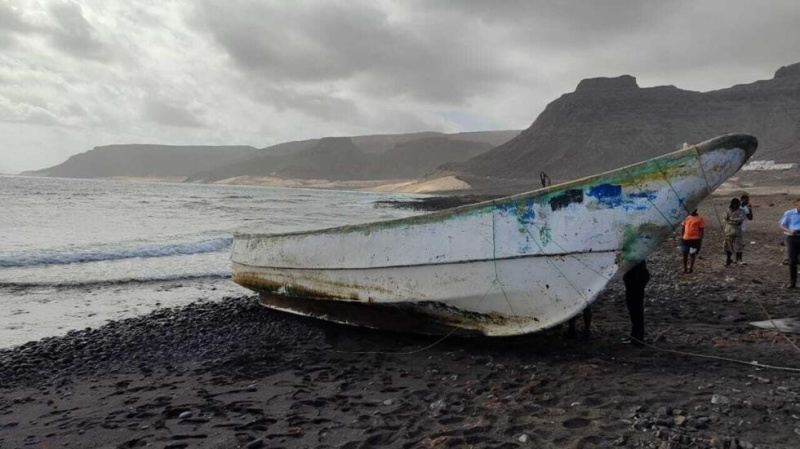
The island of São Vicente, in Cape Verde, witnessed something unusual: two artisanal boats washed ashore with Africans seeking Europe in less than four days, between Sunday and Wednesday.
Both boats left from the port city of Nouadhibou, Mauritania, but with very different stories.
The last boat brought 11 men who set sail for four days until they reached the wrong archipelago, while the first boat only left four survivors who witnessed the death of the other 60 occupants, day after day, during a month adrift.
The GPS they had on board only marked 200 kilometers (out of a total of 800) to their destination, the Canary Islands, on February 11, after four days of travel.
They ran out of food that day, but were holding on because the end of the journey was in sight, when they ran out of fuel.
At the mercy of the wind and tides, they entered a backward drift that brought hunger, thirst, and despair, says Elhadji Sow, from the team that welcomed the survivors, who heard “horrible stories.”
The survivors had to throw the bodies of those who died into the sea, including five women, to prevent decomposition on board.
At times it was the opposite: “They even tied people up to prevent them from jumping into the sea. They were the ones who had lost hope and threw themselves overboard,” to escape the harsh sun and storms, exposed to the elements and drinking seawater, describes Djibril Ndiaye, another member of the welcoming team.
“One of these survivors wears a string around his neck, a keepsake from a friend who died,” but, according to Djibril, these are all signs of “incredible trauma.”
“They will need a lot of support,” he added.
They said they paid around 700 euros to board and remembered a young man who traveled for free for the European dream because he had managed to get “a ride offered by one of the migrants.”
At the time, they thought he was lucky.
The Cape Verdean authorities welcomed all 15 male survivors from the two boats in the dorms of the Mindelo football training center, under medical and food care, confined and prevented from talking to journalists, at least for now, as the police claim there are still ongoing investigations and procedures.
Elhadji Sow and Djibril Ndiaye, Senegalese, are part of the Platform of African Communities in Cape Verde, accustomed to helping immigrants in distress and to which the civil protection asked for support, Vitória Veríssimo, the regional commander, tells.
“They are of different nationalities, with different customs [from the Cape Verdeans], some are Muslims who strictly follow the religion” and the association acts as a bridge, breaking the language barrier, even over the phone, with anxious relatives.
All four shipwreck survivors from Sunday have already spoken with family members, in Mali and France (some want to go get them, but are advised to wait for instructions), while the last group of 11 is awaiting police authorization.
Many other people who had relatives on the boat call Sow, who regrets not having good news to give.
In 2023, a total of 39,910 migrants arrived irregularly in the Canary Islands after crossings in precarious boats from the West African coast, an increase of 155% from 2022 (15,682 migrants), according to the International Organization for Migration (IOM).
Also in the last year, there were 47 shipwrecks and 958 deaths or disappearances in the official record of the so-called Atlantic route of West Africa, but the real numbers are higher.
The IOM acknowledges that, in the countries of origin, there are many clandestine departures, resulting in lost boats in the Atlantic, full of invisible victims in the statistics.
Sow and Djibril hear the motivations for this risky escape to Europe and nothing surprises them anymore: poverty, unemployment, political instability, and violence, as in Mali, the home country of 13 of the 15 men who arrived in Cape Verde – the other two from Mauritania and one from Senegal.
The 11 occupants of the Wednesday boat are all from Mopti, a riverine outpost in central Mali, who came together to buy the motorized boat with which they took to sea, and when they arrived at Baía das Gatas, in São Vicente, they walked along the beach and asked if they were in Spain.
To the authorities, they said there were more boats behind them, but since Wednesday there have been no more arrivals in Cape Verde.
In the Portuguese-speaking archipelago, repatriation to the countries of origin awaits all of them: will they try to catch another boat to Europe?
“Some will not, but that cannot be said for everyone,” Djibril says. “In a land where hope is lacking, the possibility of emigrating always arises,” despite the traumas and warnings, he adds.
“Migrant boats challenge Cape Verde’s civil protection”
The pirogue is a hallmark of fishing on the African coasts but has gained another notoriety in the last two decades, overloaded, as a common image of irregular migration to Europe.
With about ten meters long by two meters wide, the wooden and whitewashed fiber structure peels off at the edges, has a patch on the bow, and seems to accumulate years of wear, just like the wooden beams and boxes in an interior devoid of safety.
A pair of shorts, a water bottle with an Arabic label, ropes, and nets were left inside the boat that traveled a thousand kilometers from the port city of Nouadhibou, Mauritania.
“The engine was removed and is in the custody of the maritime authorities,” explained Anilton Andrade, councilor in charge of civil protection, who accompanied the operations upon the arrival of the group of 11 occupants, from Mopti, Mali, who spent four days at sea and, when they arrived, asked if they were in Spain – in the Canary Islands archipelago.
Three days earlier, another similar boat, which left from the same port, ran aground on the island of São Vicente, in the Calhau area, after a month adrift, with only four of the 65 occupants surviving.
“The first impact [when seeing the boat] is terrible, seeing people in these conditions,” describes Anilton Andrade, recalling that “there were even bodies in the other boat, for several days.”
The Cape Verdean authorities estimate that the precarious boats are easy prey for rough seas and strong winds, dragging them off course – the authorities themselves had difficulties in going out to sea for search operations, on Sunday, as the northwest wind with gusts has not stopped blowing.
Vitória Veríssimo is experienced in civil protection activities and took over as regional commander a year ago, but it is the first time she is dealing with the rescue and reception of migrants in São Vicente.
“We already had experience with civil protection on other islands” and that is helping, she explains to Lusa, upon entering the football training center of Mindelo, the space that served for isolations during the covid-19 pandemic is the same one where the 15 men who arrived in Cape Verde by Wednesday are now being transferred.
Blood samples were collected from all for analysis, malaria was ruled out – Cape Verde was declared free of the disease in January – and Covid-19, all with negative results, and a questionnaire about chronic diseases was completed.
Medical and nursing teams follow them daily, and a nutritional plan was established to restore strength, especially for the four survivors of the first boat, who, after a month adrift, could barely move – they went from the beach to the hospital on stretchers and remained hospitalized for two days.
“In general, some complain of toothaches, headaches, but they are all recovering. They are very calm, quiet people, and always cooperate with us,” even when there are language barriers, Vitória Veríssimo describes.
“They are in the rooms under custody of the National Police while the authorities do the necessary procedures” involving contacts with the countries of origin.
“As part of civil protection, we ensure health, hygiene, and talk to them,” she adds, addressing any needs.
From the windows on the second floor, they watch the football training that the local teams do on the synthetic turf of the training center.
On the ground floor, a Malian entrepreneur living in Mindelo passes by the center upon hearing about the presence of compatriots and offers to deliver one of the upcoming meals to them, an example of the gestures of local entities and individuals that have been happening.
“All civil protection entities and agents in São Vicente are committed to providing the best possible support,” Anilton Andrade concluded.
In addition to the two artisanal boats that ran ashore on the island of São Vicente this week, there have been three other cases in Cape Verde in the last 16 months.
In November 2022, a boat with 66 Senegalese immigrants washed ashore on the island of Sal.
In January 2023, a pirogue arrived on the island of Boa Vista with 90 African migrants on board, two of them dead.
A boat that departed from Senegal in July 2023, with 101 people, was found adrift near the island of Sal, Cape Verde, in August, with 38 survivors, assisted and repatriated.
Read the original article(Portuguese) on Expresso das Ilhas


