Rédaction Africa Links 24 with pierre Dieme
Published on 2024-03-09 07:42:16
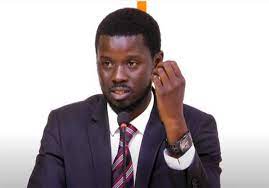
Bassirou Diomaye Faye, a candidate in the Senegalese Presidential election of 2024, presents his political program entitled “Yoonu Dëgg”.
His program, called “1.5.15”, is structured around five major directions outlined in fifteen axes, each containing several actions to be implemented. In the section “The President’s Word”, Diomaye Faye expresses his desire to lead Senegal towards a prosperous future by emphasizing the values of patriotism, work, ethics, and fraternity.
Mr. Faye highlights the importance of fighting against injustice, promoting social cohesion, and building a better future for the country together. His program also aims to strengthen democratic institutions, rethink the judicial system, improve the governance of natural resources, combat corruption, and promote Senegal’s economic sovereignty.
Diomaye Faye asserts that as president, he will oppose the instrumentalization of justice and law enforcement, intimidation of opponents and journalists, brutal repression, and arbitrary imprisonment.
Bassirou Diomaye Faye presents himself as a servant of the people and wants to rely on all skills to implement his economic and social program.
Diomaye’s Program: Reforms in the political and judicial system…
The coalition “Diomaye President” has nominated Bassirou Diomaye Faye as its candidate for the 2024 Presidential Election. He proposed the program 1.5.15 to the Senegalese people. Let’s get to know about “Institutional Renewal and African Commitment” section.
One of the sections of his political program “Yoonu Dëgg”, proposed to the Senegalese people, is “Institutional Renewal and African Commitment”. He advocates for “a profound reform of institutions and a commitment to Africa” and “an efficient administration at the service of Senegalese”.
And this program, which includes several major axes, aims to introduce significant reforms in the political, judicial, electoral, financial systems, and promote regional integration and sustainable development.
Here is a summary of the main points:
1. Reduction of the President’s prerogatives:
– End of the concentration of presidential powers.
– Establishment of responsibility, revocability, and accountability of the President.
– Introduction of the impeachment procedure in case of serious misconduct.
– Creation of the position of vice-president, elected in tandem with the President.
2. Reform of the relationship between the executive power and the judicial power:
– Transformation of the “Constitutional Council” into “Constitutional Court” with a parity mode of appointment.
– Reform of the Superior Council of the Judiciary (CSM).
– Revision of the penal code and the code of criminal procedure.
– Independence of the public prosecutor’s office from the Minister of Justice.
3. Independence within the judicial system:
– Institution of a Judge of Freedoms and Detention (JLD) for questions of pre-trial detention.
– Promotion of alternative sentences to imprisonment.
– Strengthening of the electronic monitoring system.
4. Reform of the justice budget and upgrading of places of deprivation of liberty:
– Substantial increase in the budget of the Ministry of Justice.
– Construction of new buildings: courts, administrative buildings, prisons.
– Reform of the prison policy to facilitate the social reintegration of detainees.
5. Citizens’ access to the public service of justice:
– Strengthening of access to information for litigants.
– Digitization of civil status and implementation of a community alert system on births and deaths.
– Facilitation of access to legal aid.
6. Reform of institutions and the electoral system:
– Limitation of the powers of the President.
– Prohibition of multiple elective mandates.
– Revision and protection of the Constitution.
– Adoption of a Charter of freedoms and democracy.
– Revision and improvement of the Senegalese electoral system.
7. Review of accounts and strengthening of the competence of supervisory bodies:
– Strengthening of transparency in the management of public affairs.
– Detachment of control bodies from the supervision of the Executive.
– Reform of the National Office for the Fight against Fraud and Corruption (OFNAC) and establishment of the National Financial Prosecutor’s Office (PNF).
– Abolition of political funds and adoption of a law for the protection of whistleblowers.
8. Real sub-regional and African integration:
– Strengthening of border security.
– Interconnection of infrastructures with countries in the sub-region.
– Promotion of a decentralized cooperation program.
– Construction of embassies in African countries.
– Development of renewable energy production at the sub-regional level.
Mangoné KA
Read the original article(French) on Dakar Matin