Rédaction Africa Links 24 with Linda de Jager
Published on 2024-03-22 06:40:56
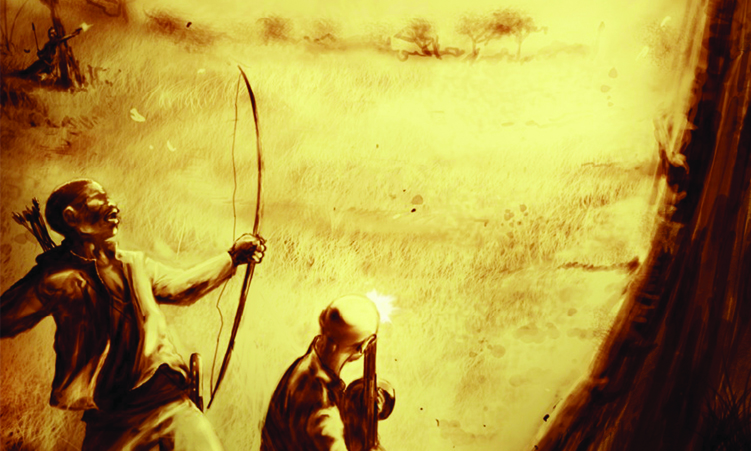
The power of a visual image to tell a story is undeniable. As the saying goes, “A picture is worth a thousand words.” The illustration accompanying this piece is a defining image from a period of conflict that lasted from 1966 to 1989 in Angola and Namibia, previously known as South West Africa.
It is hard to imagine that peace in Namibia today is often taken for granted, especially considering the low-intensity war that preceded it. The image was created in collaboration with Pitshou Mampa, a Congo-born artist. It was inspired by a cartoon published in a local newspaper during a time when the war in northern Namibia was a serious matter for the opposing forces.
The conflict began when Swapo fighters, organized as the People’s Liberation Army of Namibia (Plan), had their first clash with South African security forces at Ongulumbashe, just south of the Angolan border, in August 1966. Plan, established as the military wing of Swapo, recruited volunteers from North-Central Namibia and trained them in countries like the Soviet Union, Cuba, Egypt, and the Eastern Bloc.
One of the first Plan cadres to cross the border bearing arms was John Otto Nankudhu, a leader at the Ongulumbashe camp. He survived to recount the first skirmish that marked the beginning of a 23-year conflict. In March 1965, six Plan cadres left Tanzania with Russian sub-machine guns and pistols, walking over 6,000km to establish training camps and open the front in Namibia.
During the first skirmish, which occurred at Ongulumbashe, the South African security forces were met with cadres armed with bows and arrows in addition to firearms. Despite the odds, the cadres stood their ground, displaying immense courage and determination in the face of a superior force.
As the conflict continued, the South African Defence Force (SADF) maintained an advantage in weaponry, but the guerrillas of Plan, supported by their allies, adapted and developed their arsenal. The introduction of armoured vehicles, radar-controlled anti-aircraft artillery, and missiles escalated the war, forcing both sides to continuously evolve their strategies and capabilities.
Reflecting on the image of Ongulumbashe, we are reminded that even the underdog, armed with simple weapons like a sling or a bow and arrow, can stand against a formidable opponent. Namibia’s journey to independence in 1990 serves as a testament to the strength and perseverance of its people in the pursuit of peace.
In a world plagued by conflicts, Namibia’s history demonstrates that peace, though unlikely at times, is always possible. The real challenge lies in maintaining that peace as the country moves forward into the future. It serves as a reminder that peace is a precious commodity that must be nurtured and protected.
The story of Namibia’s struggle for independence and peace is a vital part of its history. It serves as a beacon of hope in a world filled with turmoil and division. Through the lessons learned from their past, Namibians continue to strive for a better future for themselves and their country.
Read the original article on The Namibian