Rédaction Africa Links 24 with Staff Reporter
Published on 2024-03-26 17:00:00
Namibia is now known as one of four countries that are home to a new species of African bullfrog. This recent discovery was made by Professor Louis du Preez and his team of researchers from the North-West University (NWU) in South Africa. The newly identified species, Pyxicephalus beytelli, marks only the fourth species of bullfrog ever identified in southern Africa.
The distribution of the Pyxicephalus beytelli species spans across parts of north-eastern Namibia, southern Angola, south-western Zambia, and north-western Botswana. It is named after the late Ben Beytell, a key figure in the conservation efforts of Namibia, specifically in the establishment of Khaudum National Park where the species is found.
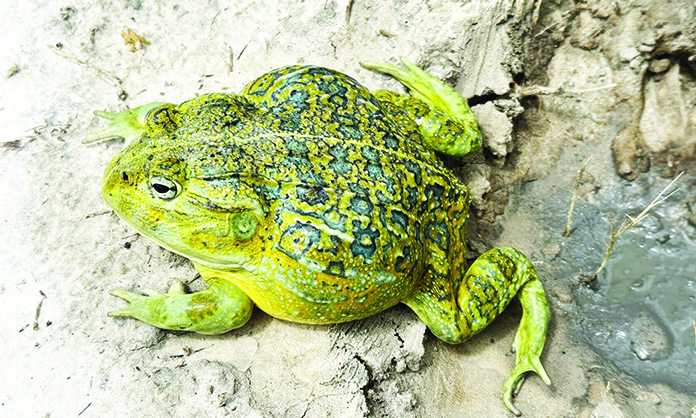
While the new species shares similarities with other bullfrogs in terms of external structure, internal anatomy, and general behavior, it stands out with its distinct bright yellow and lime green coloring, blue spots, and a white vertebral line running down its body. The frog’s most prominent features are its ferocious teeth, sloped backwards with two large bony protrusions on the lower jaw, making it an intriguing subject for further study.
Professor Du Preez highlights the importance of understanding the feeding habits of Pyxicephalus beytelli, noting their varied diet that includes mice, small birds, snakes, insects, and even other frogs. The discovery of this new species was a result of a thorough survey conducted by Du Preez and his team in Khaudum National Park, commissioned by the Namibian Nature Foundation.
The challenging terrain of the bullfrog’s habitat made it difficult for researchers to reach and study the species, contributing to its belated discovery. Du Preez emphasizes the crucial role of identifying new species in conservation efforts, particularly in protecting frogs, which are among the most threatened group of vertebrates in the world due to habitat destruction.
“Frogs evolved about 350 million years ago and have diversified since then. Today, they are facing serious threats, largely due to habitat destruction. Understanding the location and range of a species is essential for its protection. It is only after a species is extinct that we realize the extent of our loss,” explains Du Preez.
With much still to learn about the newly discovered Pyxicephalus beytelli species, researchers are excited about the prospect of uncovering more information about its ecology and behavior. The ongoing study of this new species presents an opportunity for further scientific exploration and conservation efforts to ensure its long-term survival in the wild.
In conclusion, the discovery of Pyxicephalus beytelli adds to the rich biodiversity of African bullfrogs and underscores the importance of continued research and conservation initiatives to protect vulnerable species and their habitats. This newfound species serves as a reminder of the vast diversity of life on our planet and the importance of preserving it for future generations.
Read the original article on The Namibian


