Rédaction Africa Links 24 with Tangeni Amupadhi
Published on 2024-03-30 06:00:00
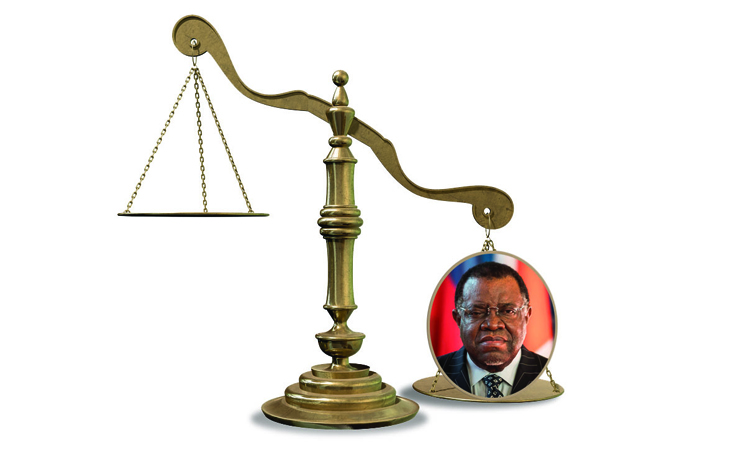
Geingob Legacy – Scorecard
I will miss Hage Gottfried Geingob. That might sound cynical considering the critical news stories, analyses and opinions I have written or approved for publication. But I mean it.
Neither a wholly scathing nor a blindly favourable obituary will do justice to Geingob’s legacy.
Geingob was not only a prolific newsmaker, which made him great currency for the media industry, but he created an atmosphere for genuine interaction with the public unlike any other elected political office bearer.
Critics will miss him because he was responsive to public condemnation; ardent supporters will miss him because he could as easily dispense patronage to sycophants.
He could be likeably engaging in one moment and come across as bullish at another. He did not hesitate to use the positions he occupied as a bully pulpit.
Geingob was a more complex figure than the boisterous public persona many came to know. He fancied himself as an intellectual wielding power and at the same time a man of the people. Playing to the gallery seemed to come naturally to him at times.
The following are a few areas that stand out on Geingob’s role in independent Namibia’s politics over more than 30 years.
CIVIL LIBERTIES: SCORE 6/10
On LGBTQ+:
At core, Geingob seemed to believe in the predominance of individual civil liberties against the tyranny of the majority. He adapted a ‘live and let live’ approach towards LGBTQ issues, at times even admonishing posturing by gay rights advocates as uncalled for. It was clear he’d not sign into law parliament’s populist bills against same-sex marriages. Yet he was politically savvy enough not to verbalize his position knowing it was political suicide in Swapo and among conservative Namibians to defend same-sex activities.
Media Freedoms:
For someone who loved the limelight and accolades of the media, Geingob professed unequivocal support for press freedom. Yet his actions were often ambivalent. As prime minister under president Sam Nujoma who brooked no dissent, Geingob could be forgiven for burying his head in the sand when Cabinet in 2001 banned both government purchase and advertising in The Namibian in addition to overt interference at the Namibian Broadcasting Corporation.
But it was perplexing when he became president that the Geingob Cabinet took a decision to deliberately favor state-funded media for the release of information and advertising at the expense of private media and independent journalism.
His pro-press freedom rhetoric was strong but ensuring putting in place state support for tools such as the access to information law as advocated under the AU’s African and People’s Rights Charter limped along. His death leaves uncertainty over how soon the access to information law will become operational.
It makes me wonder whether his rhetoric was more for political expediency and accolades than principled position.
CONSTITUTIONAL DEVELOPMENT: SCORE 8/10
An authoritarian (even a lite version) in the mould of Donald Trump, Vladimir Putin or Xi Jinping, he surely was not despite an often bullying posture.
The man loved a debate with anyone, at any given time, as his Western-style town hall meetings and impromptu walkabouts showed.
Geingob’s chairmanship of the Constituent Assembly in 1989-1990 elevated him to a position of statesmanship unparalleled among his peers of elected politicians.
Namibia’s liberal democracy Constitution dovetails with Geingob’s public persona as someone who loved to express himself freely.
Some blots on Geingob’s role and beliefs that the Constitution is not merely a paper to be toyed with occurred twice: When he led changes for the sake of one person by allowing founding president Nujoma to rule for a third term; and in 2014, Geingob pushed through amendments aimed at strengthening his hand by increasing the number of lawmakers, ostensibly to neutralize his opponents in Swapo.
The Nujoma third term seemed merely aimed at avoiding a clash with his master. The 2014 expediency amendments needlessly bloated parliament and Cabinet with little to show in terms of the quality of lawmakers.
ANTI-CORRUPTION: SCORE 3/10
Geingob’s public pronouncements against corruption were clear but were not backed up by actions.
As prime minister, Geingob led the drafting of the anti-corruption law. What eventually passed in parliament was so watered down it rendered the Anti-Corruption Commission (ACC) toothless. Small wonder the implementation of the anti-corruption law was bequeathed to president Hifikepunye Pohamba and prime minister Nahas Angula, who themselves did such a poor job in choosing the weakest candidates to lead a crucial governance institution.
Instruments such as the whistleblower protection law and lifestyle audits remain in the starting blocks.
Not only was the late president implicated in taking kickbacks (accusations of corruption that he vehemently dismissed), Geingob didn’t help that image whenever he moved in the company of people whose business dealings depended on the patronage of government officials and the state.
Geingob declared getting medical treatment paid for by Namibia’s leading oil exploration magnate, Knowledge Katti, who has been pinpointed in several reports as a person of political and economic interest with close connections to government leaders.
Geingob was paid hundreds of thousand of dollars for allegedly facilitating a license between mining company UraMin and French nuclear giant Areva.
His friendship with Benin national Ernest Adjovi, accused of swindling Namibia out of N$23 million on the promise of hosting the continental Kora music awards, left a stain on the departed president.
As trade minister and president, Geingob pushed for establishing the government-funded SME Bank despite reports that Zimbabwean businessman Enoch Kamushinda had a checkered history dealing with depositors’ and creditors’ money. About N$250 million has since been established as stolen from the SME Bank.
Geingob challenged all and sundry to prove that he played a role in the Fishrot scandal, in which two former ministers and business executives are standing trial. The jury is out. Nonetheless, Geingob has come under scrutiny that he should have acted sooner to stop the schemes.
On the upside, the steps the late president and his wife Monica Geingos took to publicly declare their assets were positively unprecedented in the promotion of transparency and anti-corruption.
Such was the complex nature of Geingob.
SYSTEMS, PROCESSES AND INSTITUTIONS: SCORE 7/10
During his presidency, especially during his second term, Geingob drove the mantra of entrenching systems, processes and institutions above individuals.
It might seem ironic because Geingob’s stamp of authority stood above many others during Namibia’s independence as one person who shaped the administrative infrastructure of the country.
Geingob brought to the presidency an aura not seen since Nujoma was in power.
So it seemed strange at times whether he was avoiding dealing with the mess of issues like the Fishrot scandal or trying to keep at bay Swapo comrades who tried to undermine his authority as state president.
Some have criticized the decision to run the green hydrogen projects out of the presidency instead of the line ministry as going against the grain of the systems, processes, and institutions mantra.
The swift installment of Nangolo Mbumba as president less than 24 hours after Geingob’s death was a key indicator of systems, processes, and institutions at work. But that should be the minimum expectation in a democracy.
The real test of whether Geingob’s mantra is entrenched will be when there’s a smooth transition if Swapo is voted out of power.
For now, I’m convinced many of us will miss Hage Gottfried Geingob because he was a vibrant figure; he was easy to engage with, and that provided space for democratic debate.
If I were a political opponent, Geingob would easily top the list of worthy adversaries.
To borrow from Hunter S Thompson’s obituary of Richard Nixon: Hage Geingob is gone, and I’m poorer for that… He was, after all, the president, and an exciting, excitable leader.
* Tangeni Amupadhi has worked as a journalist since 1991, covering the intersection of business and politics. He has been managing director and editor of The Namibian since 2011.
Stay informed with The Namibian – your source for credible journalism. Get in-depth reporting and opinions for only N$85 a month. Invest in journalism, invest in democracy – Subscribe Now!
Read the original article on The Namibian