Rédaction Africa Links 24 with Anass Machloukh
Published on 2024-03-11 11:31:00
There is no doubt that Africa is the new El Dorado for China, which has strengthened its presence on the continent over the past twenty years in such a remarkable way that it has become the largest trading partner of the African continent with a trade volume exceeding $263.3 billion. Beijing has rooted itself in Africa to the point that its Belt and Road Initiative worries its international rivals. As the continent transforms into a fierce battleground for competition between global powers competing for influence, China is banking on mutually beneficial business. The Middle Kingdom does not intend to stop there and sees further opportunities. There is no better opportunity than the upcoming Forum on China-Africa Cooperation (FOCAC) which will take place next autumn in Beijing, according to Chinese Foreign Minister Wang Yi. The Chinese government aims to make this essential meeting a platform for exchanges and debates on the future of China-Africa cooperation in the years to come. Minister Wang expressed his country’s willingness to “open up new horizons for common development”.
According to information available, Morocco will participate in this annual event as it has done in previous years. However, the level of participation is still to be determined, according to a diplomatic source. For the Kingdom, the goal is clear. It aims to step up its economic partnership at a time when economic cooperation has never been more prosperous, even though both countries are capable of doing more. Morocco has expressed its expectations through its ambassador to Beijing, Abdelkader El Ansari, who stated in an interview with Chinese state television CGTN that Morocco is “ready to position itself as a key economic partner of China due to the excellent relations between the two countries and their markets representing hubs in their respective regions”. Therefore, Morocco’s strategy is clear. Presenting itself as a gateway to Africa, Morocco aims to position itself as a regional hub for Chinese investments.
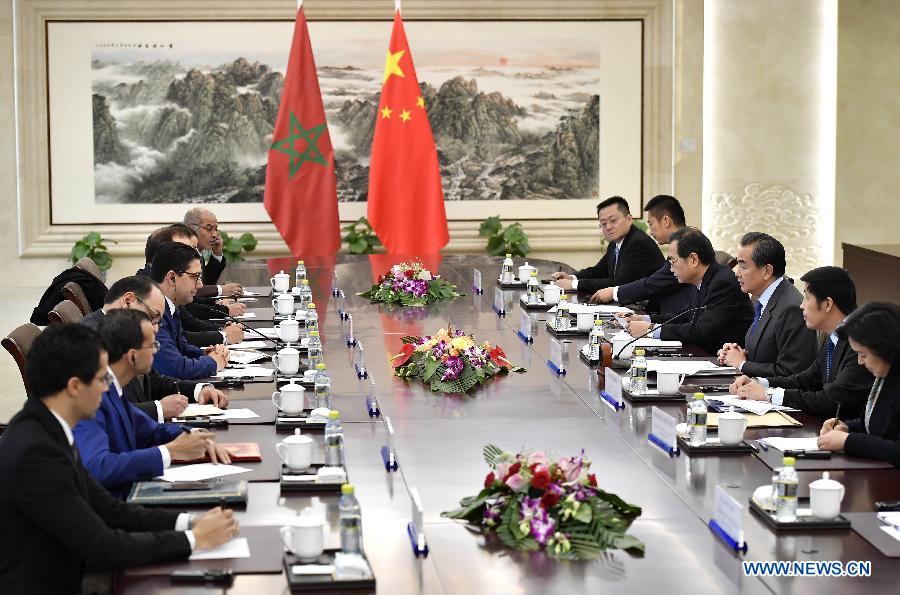
This statement is not coincidental and appears to be made at a time when Rabat and Beijing are working to enhance their economic cooperation. This was the subject of the recent meeting between the Moroccan Minister of Industry and Commerce, Ryad Mezzour, and his Chinese counterpart, Wang Wentao, in Rabat. The Chinese Minister, on behalf of China, expressed the desire to “promote cooperation between the two countries”. Examining his statements after the meeting, it is evident that Beijing intends to play two main cards to strengthen its presence in Morocco. First, it aims to increase its investments through its companies. Secondly, Beijing intends to seize the potential of the African Continental Free Trade Area to promote trade.
Morocco also seeks to establish itself further as a preferred destination for Chinese investors by leveraging the free trade agreements it has signed, providing access to a market of 2.4 billion consumers. This was explained by the Moroccan ambassador in an interview with CGTN.
Currently, Rabat and Beijing are aiming to strengthen their cooperation at a time when the indicators are positive. Bilateral trade continues to grow, with a 50% increase in trade volume in 2022, reaching $7.6 billion. This makes China the third largest trading partner of the Kingdom and its main partner in Asia. This positive momentum also applies to investments, which reached $56 million in 2022. Chinese FDI is spread across several sectors, including industry, infrastructure, transportation, real estate, energy, and mining. Industry accounts for the majority at 52%. However, according to Moroccan authorities, China can do more and invest more. Abdelkader El Ansari was clear in stating that Chinese investments in Morocco fall short of the potential of the two countries.
Morocco also aims to balance its trade with China as much as possible, given its trade deficit with the Asian giant. The deficit continues to worsen each year, surpassing $70.6 billion in 2023. The bleeding has been ongoing since 2011. This is why Minister Ryad Mezzour advocated for “enhanced accessibility” of Moroccan companies in the Chinese market during his meeting with his Chinese counterpart in Rabat.
Meanwhile, Morocco is also banking on increased Chinese investments to offset commercial losses. It is worth noting that China is not even in the top 5 countries for FDI flows. This concern is shared by Chinese authorities, as Ambassador Li Changlin pointed out in a previous interview that “China is not desperately seeking a trade surplus” and that this is not their ultimate goal.
Both countries now aim to build on the achievements thus far and move forward. Projects are being prepared to attract more Chinese investors. This was the subject of a Cooperation Memorandum signed in April 2023 between the Moroccan Agency for the Development of Investments and Exports (AMDIE), the Wuhan Economic Development Zone, and the International Federation of Chinese Entrepreneurs during the Road Show organized by the AMDIE in China. This agreement aims to attract Chinese investments, especially in the automotive sector. Morocco seems to be focusing on this strategic sector by leveraging Chinese technology to develop an ecosystem for the production of electric vehicles.
A first step has been taken with the signing of a memorandum of understanding between AMDIE and the Sino-European giant Gotion High-tech to establish a factory for electric battery production in Morocco with an estimated investment of $65 billion. This first gigafactory, the first in Africa, is expected to mark the birth of a new cutting-edge sector in Morocco and pave the way for increased Chinese presence in the Kingdom. However, it is essential to translate these announcements into reality.
Read the original article(French) on L’Opinion