Rédaction Africa Links 24 with Mohamed Badrane
Published on 2024-04-09 08:50:05
Paris joins Washington and Moscow in the race to equip Morocco with a nuclear reactor for electricity production
Energy: The markets launched by Morocco in the field of infrastructure continue to attract the interest of major global players, with a particular focus on the energy sector and its geopolitical implications. Insights.
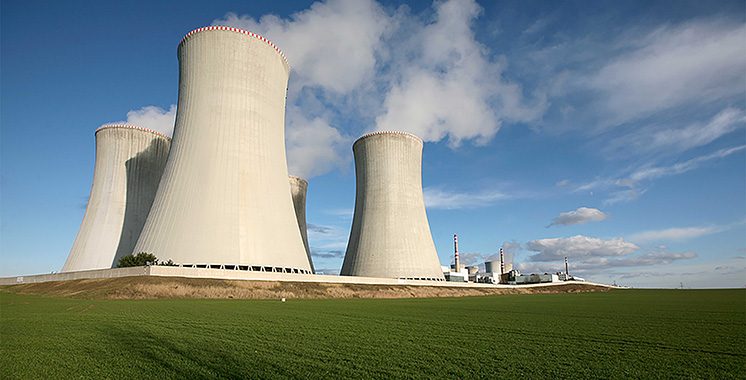
One reactor, three global powers, and one client. It seems that Morocco is on the verge of realizing its project dating back to the 1960s to produce nuclear energy. While the Kingdom is moving forward to power a future desalination plant with nuclear energy, the race is on among different global players to secure this market. Americans, Russians, and now the French are in the running. While the Russians have shown interest by signing an agreement with the Kingdom, lobbyists in the United States are pushing for the White House to authorize the transfer of new nuclear technology to Morocco. Meanwhile, the French have been making a similar proposal for some time now. The issue was raised during the visit to Morocco by the French Minister Delegate for Foreign Trade, Attractiveness, Francophonie, and French Nationals Abroad, Franck Riester. The debate revolves around small-sized reactors or “SMRs.”
According to the International Atomic Energy Agency (IAEA), small or medium-sized reactors, or small modular reactors, provide a flexible solution for electricity production that can meet the needs of a wider range of users and applications. These small modular reactors, deployable as single modules or multi-module systems, can be coupled with other energy sources, including renewable energies. The choice of this new generation for countries like Morocco is significant. According to the same source, modular reactors are gaining interest worldwide because they offer a flexible way to produce electricity for a wider range of users and applications, and they could replace aging fossil fuel power plants. They also demonstrate improved safety performance through intrinsic and passive safety features, require a lower initial investment than conventional technologies, and allow for co-generation and non-electrical applications.
The French energy company EDF, also present in Morocco, had established a subsidiary to develop small nuclear reactors.
Morocco, a nuclear producer
A few months ago, the Director of the International Atomic Energy Agency (IAEA), Rafael Mariano Grossi, made headlines by stating that Morocco would soon become a nuclear energy producer. According to the head of the IAEA, speaking to international media, there should be about a dozen new nuclear countries in the next ten years, including Ghana, Kenya, Morocco, Nigeria, Namibia, the Philippines, Kazakhstan, and Uzbekistan. Things seem to be moving quickly for Morocco. In this regard, the Russian government approved in 2022 a cooperation agreement between Moscow and Rabat in the field of using atomic energy for peaceful purposes. The agreement, which aims to implement cooperation between the two countries in at least 14 areas, was negotiated by the Russian state company Rosatom and coordinated with the Russian Ministry of Foreign Affairs, as well as other authorities, and previously agreed with the Moroccan side.
Rosatom is one of the leaders in the field of SMRs, small modular reactors ranging from 30 to 350 megawatts. In the United States, the influential think tank Middle East Institute called on the White House in 2023 to consider engaging Rabat as a stakeholder in the deployment of the U.S.’s 4th mobile nuclear technology. According to the Middle East Institute, the use of renewable energy sources, particularly solar and wind energy, to address the food-water-energy trilemma ultimately depends on the ability of technologies to provide scalable solutions to meet immediate needs. Mobile desalination units powered by modular nuclear energy can provide more easily deployable solutions as the urgency of the food and water crisis in the MENA region accelerates due to climate change. In France, EDF, a major energy company also present in Morocco, established a subsidiary to develop small nuclear reactors. Specifically, the subsidiary Nuward is the continuation of the project of the same name on which EDF’s teams have been working for several years. The French energy giant aims to become one of the European leaders in small nuclear reactors or SMRs.
Support from the IAEA
While waiting for detailed offers, Morocco is strengthening its existing mechanisms. In this regard, a team of experts from the International Atomic Energy Agency stated at the end of 2023 that Morocco is committed to maintaining and strengthening its regulatory framework for nuclear and radiological safety. The team emphasized that the country has taken effective measures to establish a new coherent legal and regulatory framework for nuclear and radiological safety. It recommended additional measures to finalize the transition of the legislative, regulatory, and institutional infrastructure initially built on the 1971 law and align new regulations with IAEA safety standards. The team also recommended improving regulatory control of the research reactor. The Integrated Regulatory Review Service (IRRS) team concluded its 10-day mission in Morocco on December 6, 2023. The mission was conducted at the request of the Moroccan government and was hosted by the Moroccan Agency for Nuclear and Radiological Safety and Security (AMSSNuR), the national regulatory body for nuclear and radiological safety and security.
***END OF TRANSLATION***
Read the original article(French) on Aujourdhui.ma