Rédaction Africa Links 24 with alm
Published on 2024-03-29 12:05:33
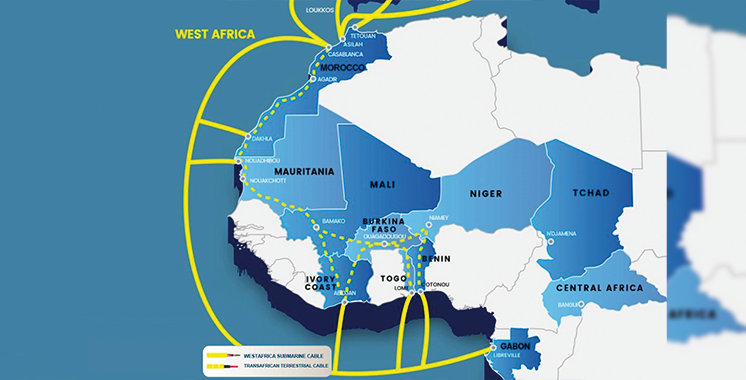
Thanks to its robust infrastructure, Maroc Telecom has stabilized the connectivity of the region following incidents on the undersea fiber optic cables in West and Central Africa. The malfunctioning of Internet services in West Africa highlighted the major role played by Maroc Telecom in the continent. Indeed, the telecom operator provided great support to countries affected by this major outage, which led to disruptions in Internet access in many countries. In order to meet the needs of the operators in the region affected by these incidents, teams from Moov Africa and Maroc Telecom Group mobilized to establish new capacities on the West Africa undersea cable and at Maroc Telecom’s Internet Points of Presence (PoPs) in Morocco. This allowed several competitors to remain connected. Thanks to its robust infrastructure, Maroc Telecom thus stabilized the connectivity of the region following the incidents on the undersea fiber optic cables in West and Central Africa. Its West Africa undersea cable is a new proof of the resilience of the network of Maroc Telecom Group and of Africa’s independence through Internet connectivity. It should be noted that only operators from Moov Africa, a subsidiary of Maroc Telecom Group, were spared from this widespread outage. Indeed, Moov Africa Côte d’Ivoire customers are connected to the Internet via Maroc Telecom Group’s West Africa undersea cable, which links West Africa to Europe via Morocco through 8 landing points. With a length of 9,400 km and a capacity ranging from 20 to 60 Tbps, this cable runs along the West African coast from Gabon to Morocco, with an extension to Portugal with 8 landing points spread across 7 countries.
Maroc Telecom saw its international revenue increase by 6.6%, totaling 18.38 billion dirhams. This growth is due to the combined effect of Mobile Data (+22.6% at constant exchange rates), fixed Internet (+11.3% at constant exchange rates) and Mobile Money (+5% at constant exchange rates) growth. “Excluding call terminations, subsidiary revenues increased by 3.8% at constant exchange rates,” commented the operator. As for the adjusted net income attributable to the group (ANIG), Maroc Telecom noted a 6.4% increase (+5.7% at constant exchange rates) to reach 6.19 billion dirhams by the end of 2023. The adjusted consolidated operating income (EBITA – earnings before interest, tax and amortization) reached 12.22 billion dirhams, an increase of 6.6% (+5.5% at constant exchange rates). The adjusted EBITA margin rate stood at 33.2% (+1.3 percentage points at constant exchange rates over one year). As for the adjusted consolidated operating income before depreciation (EBITDA), it improved by 4.7% to over 19.36 billion dirhams (+3.5% at constant exchange rates). This increase was driven by the growth of consolidated revenue and efficient cost management. “The adjusted EBITDA margin rate appreciated by 0.9 percentage points (+1.0 point at constant exchange rates), thanks to the increase in revenue and rigorous cost management,” Maroc Telecom reported.
It should be noted that 21.3% of the revenue generated by the end of 2023 consists of investments excluding frequencies and licenses, in line with the Group’s objectives. Furthermore, the net cash flow from operations (CFFO) showed a 10.6% decline at constant exchange rates, reaching 10.21 billion dirhams, while the Group’s consolidated net debt represents 0.8 times the Group’s annual EBITDA. By the end of 2023, Maroc Telecom saw its customer base grow by 0.7% to reach 76 million clients. This growth is driven by the customer base in Morocco (+1%) and in subsidiaries (+0.6%). At the national level, the Mobile subscriber base counts 19.8 million clients, an increase of 2.7% over the year, thanks to the combined growth of postpaid (+3.4%) and prepaid (+2.6%). As for the Fixed line subscriber base, the operator recorded 1.8 million lines by the end of December 2023, a decrease of 7.8%. The High-Speed Internet subscriber base counts nearly 1.6 million subscribers, with a strong growth in FTTH subscribers (+41%).
Internationally, the Mobile subscriber base reached 52,233,000 clients, distributed in Burkina Faso (11,563,000), Côte d’Ivoire (10,260,000), Mali (8,351,000), Chad (6,201,000), Benin (5,747,000), Niger (3,238,000), Togo (2,862,000), Mauritania (2,242,000), Gabon (1,516,000) and Central African Republic (253,000). The Fixed line subscriber base reached 391,000 subscribers, distributed in Mali (233,000), Burkina Faso (75,000), Gabon (55,000) and Mauritania (29,000), while the Fixed broadband subscriber base stood at 203,000 clients.
Read the original article(French) on Aujourdhui.ma