Rédaction Africa Links 24 with Sarah Jane Lebrasse
Published on 2024-02-27 09:35:57
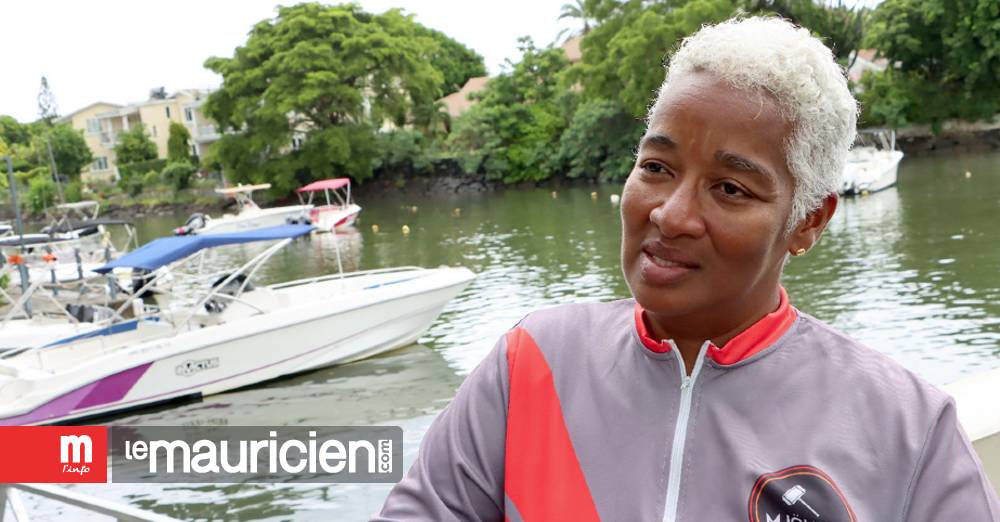
Floriane Jhungur, 53 years old, is a skipper. When this former teacher obtained her license to practice her new profession, she was already in her fifties. Owner of the Mjölnir, a fiberglass boat moored at the pontoon of L’Estuaire, La Balise Marina, Floriane Jhungur naturally immersed herself in the world of her husband, Harry, a marine mechanic specialist. Together, alongside their children, Ygor and Lucy, who are also skippers, the couple sails the Mjölnir with passengers and Mauritians who enjoy the idyllic landscapes of the west coast, or when they go to meet dolphins and sperm whales. Floriane Jhungur fully savors her professional retraining. She has made her place in a field still dominated by men.
In 2019, after spending 28 years in non-formal education, Floriane Jhungur closed the chapter on a successful career in education. However, at 49 years old, retirement was not yet on the cards. In the meantime, the Saint-Luc center of the Loreto Institute, where she worked, closed its doors. If she had stayed on at the institute, Floriane Jhungur would have taken on other roles within the Catholic education system. But after three years of reflection, she made her decision. At that time, there was no talk of boats, of a new life on the water. However, even though Floriane Jhungur was putting an end to her career in education, she did not intend to stop there. “I was tired. I had reached a point where I felt I had given everything and had nothing more to offer. The decision to leave the education sector was the result of reflection and a state of mind that lasted almost three years. Since 2016, I would come home exhausted, but I would continue working. It was wearing me down, physically and mentally. Some would say I was having a burnout… I don’t know if that’s what it was. However, I was listening to my body. And I understood that I had to stop everything and not just take a break to return to education later. When I feel like I’m going to hit a wall, I refrain from persisting, it’s an effort that requires a lot of energy,” explains Floriane Jhungur.
It was not without sadness that the former educator said goodbye to a profession she had embraced out of vocation and whose primary interest is the child. In nearly three decades, she has seen children pass through who have grown up outside the mainstream to become responsible adults, and who today make her proud. These young people have given her reason to invest in informal education. The Loreto Institute, she says, “had the good intuition to place the child at the center of development and education.” Raising awareness about cetaceans
Floriane Jhungur cannot help but elaborate, the educator is never far away: “We identify and work on the child’s talents without neglecting learning to read and math. It is an education that aims to value the learner, to help them flourish and to understand that they have the skills to succeed in life. At the end of their studies, they are able to recognize the values they possess. They don’t need to wait for someone to tell them.” She would have liked to have seen “real” profound changes in the education system before her career change, she says. Just as she would have liked educators to be better listened to. “If we aspire to change, it is essential to know how to listen to those in the field and not just pay attention to them once in a blue moon. But decision-makers have preconceived opinions and think that what is written on paper can be implemented. They forget that there are different ways of learning and that not all young people can be directed down the same path,” she observes.
In the marina lobby where she receives us, Floriane Jhungur gazes out at the sea while discussing the latest education reform and its weaknesses, the Extended Program, and the feeling of exclusion that emanates from it, the chain of strategies with uncertain results. Pedagogy is undoubtedly the common denominator between her current profession and teaching. The children who accompany their parents on board the Mjölnir find books of their age in which they discover Mauritius. “We talk about the blue economy. But how many young people have access to sea outings to understand the meaning of the blue economy outside the walls of the school? I would like to introduce children to maritime professions. And tell Mauritians that we are incredibly fortunate to live on an island that has so much to offer us,” says the skipper.
Driven by her passion for her profession and the respect she has for the marine environment, Floriane Jhungur has a project in mind. She wants to raise awareness about the protection of the marine ecosystem and the cetaceans that she and her fellow skippers encounter almost every time they go out. The desire to undertake new initiatives related to the marine world animates her, despite not coming from a family of marine professionals. To her children, Lucy and Ygor, both in their twenties, she has instilled an interest in the profession she practices. If Ygor, meticulous, she says, stands out for his dexterity, Lucy – who is heading towards studies in hospitality – pragmatic and visionary, brings her optimism to the family team. And without their father Harry, their story with the sea would not have been complete. Floriane Jhungur’s story would not have even begun. “What will you do now?” When this question was posed to her by her husband, Floriane Jhungur, who had just left teaching, didn’t have an answer. All she wanted at that moment was to take care of her loved ones, to take a breather and move forward. Her steps led her towards entrepreneurship preparation. While it was obvious that one day her husband would start his own business with the acquisition of his first boats (with permits in hand) and offering his expertise in marine mechanics, the aspiring skipper herself jumped in when the Mjölnir emerged from the workshop in 2021. A few years earlier, a trip aboard the family’s first boat, a Quintrex model, had caused an unforgettable stir in her. “I was in awe of the magnificence of the sea. It deeply impacted me,” recounts Floriane Jhungur. This emotion that remained essential in her professional retraining at a time when everything was coming together for her to bring her expertise to a budding family business.
As Eleanor approached the country this week, the Mjölnir, like other boats that had set sail earlier, slowly returned to the marina. “This morning, we welcomed Russians,” explains the boat owner. While she doesn’t always take the helm of her boat, it’s because responsibilities are divided. The skipper and his assistant are on board. “I was once told that I shouldn’t worry, that if I wanted to stay at home to work, it was fine. But I want to be out there and be in contact with clients and those I meet at the marina. I have always communicated with others. I am someone who needs interaction. That’s why I am in charge of communication for Mjölnir Expedition,” says Floriane Jhungur. But she does not limit herself to this role. While her husband takes care of mechanical maintenance, she ensures the washing of her boat every time it returns to the marina. “The name was given in reference to Thor’s hammer,” explains Floriane Jhungur. It was chosen for its symbolism; the hammer of the Norse god Thor is the most powerful weapon of the gods, protecting the universe without ever failing. Fulfilled? There is no doubt, Floriane Jhungur is in her element and has found balance in the lagoon of her island. Female skippers are not many, and she believes that they have a rightful place in this predominantly male environment. Her new challenges, including ensuring the visibility of the Mjölnir in the excursion market, are now elsewhere than in a classroom. For this, the boss gets up before dawn every day when her boat is out to prepare meals for her clients. At the helm or in the galley, Floriane Jhungur leads the operations…
Read the original article(French) on Le Mauricien