Rédaction Africa Links 24 with lemauricien
Published on 2024-03-29 13:00:11
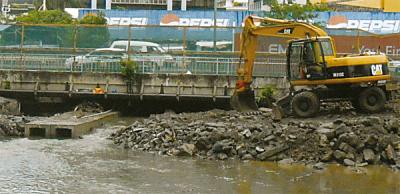
“It will be a crime to cover the Ruisseau du Pouce canal. There are already two sites in Port-Louis – opposite the Pailles-en-Queue Building and next to the Kentucky on the Chaussée – where similar works have been carried out. And we know very well the degree of pollution and damage that can be caused during heavy rains by covering a canal where a stream flows. These works will prevent the normal flow of water…”. These are the words of a former lord mayor, Mr. Sunil Gopal, published in the Weekend edition of July 16, 2000. He expressed his fears “about the harmful consequences that any covering work on the canal where the waters from the Pouce flow will cause.” (Same)
According to another investigation by Weekend signed by Marylène François and published in its edition of April 20, 2003, the Ruisseau du Pouce “has been serving as a drain since its construction during the French era.” Furthermore, “there are also the English Canal and many other similar infrastructures in Port-Louis and its immediate surroundings precisely to control the flow of waters under heavy load.” (Same). Then there was a sense of neglect that settled in. “However, Port-Louis has developed. Construction has taken place without an overall development plan, sometimes without permits, and often directly on these drains.” (Same)
The reason for these floods
“Why are some areas so often flooded? The Gibb report, for which the experts worked from July 16, 2001 to October 14, 2002 under a contract of Rs7.99 million, elaborates: “inadequacy, lack of maintenance and clogging of drains; silting and vegetation growth in river beds and banks; encroachment in natural water courses; inadequacy of waterway at bridges and culverts, etc.” (Same)
To solve this problem, it would require “for Port-Louis alone works worth Rs 137 million… for 26 strategic points, which will spare us from the heavy rains or cyclonic inundations.” (Same) With the known consequences – flooding of public roads, private houses, underground car parks like that of the Harbour Front building.
Infrastructure development v/s natural water flow
One case mentioned in the text deserves attention to understand how infrastructure development can hinder the natural flow of water and cause irreparable damage. “The flooded highway during the last rains in front of the Port-Louis Waterfront as well as John Kennedy Street would, according to the Lord Mayor, Mr. Gérard Nina, be the result of the works undertaken by the Rogers company for the creation of a parking lot by covering a part of the Ruisseau du Pouce canal. False, retorts Rogers company which also claims to have the necessary permit for these works. Let’s see: there is indeed a letter dated September 5, 1996 stating the authorization by the Port-Louis Municipal Council at the request of Rogers ‘to cover part of Pouce Stream for the construction of a private car park subject to the conditions herewith attached’. ”(Same)
The request is clear, “except that the permission to cover the canal is subject to 15 conditions and the most important question, in our opinion, is whether these conditions were respected or if the municipal inspection of Port-Louis has been attentive. Mr. Roger Lagesse, director of Corporate Affairs at Rogers, confirms: “the conditions are being respected.” And they are interesting for more than one reason… First, the fact that 25% of the covered site must be “for public use such as public parking.” Then the covering works must be approved beforehand by the City Engineer and must be of a height that allows free access to the Scavengers, etc. Rogers is obliged to assume the responsibility for regularly cleaning this part of the canal and the company “would have to furnish a monthly return of cleanings effected to the Municipality Council.” (Same)
Furthermore, the Butte à Thonniers Stream must remain as it is, that is, not covered, except for the flowers “on the metallic frame” existing. At the beginning, there was an exchange of land in the balance: the Sugar Industry Fund Board accepted an exchange of land at Rogers Square, about 370 square meters of public land against 140 meters belonging to SIFB. The existence of the underground passage – the former Rogers Square – leading to the Port-Louis Waterfront proves that this condition was respected.
Municipal/Rogers conflict over the canal covering project
Eight years later, on January 5, 2003, Rogers decided to expand its parking lot with a project worth Rs 4 million. The works should be fully completed within three weeks as the slab comprising the esplanade of the new parking lot is drying and the supporting pillars are still there.
But the Municipal Council persists, in a letter dated April 14, 2003 sent by the Deputy City Engineer to the Town Clerk to support that Rogers’ works for its parking lot continue “without an appropriate Development Permit and a Building Permit.” Another report from the city’s assistant engineer dated January 30, 2003 already leaves no doubt about the possible consequences:
“All the stones removed from the bed has been partly piled at a particular place and some seem to have been carried away” (Same). However, it is the next paragraph that catches the attention:
“Casting of the cover slab over the stream which we presume will be done, will limit the cross-sectional area and looking into the volume of water that drains from the vast catchment area may prove to the catastrophic during continuous heavy rainfall whereby we may be liable to reinstate damages caused to public/private properties.” (Same)
Which later proved to be true: catastrophic during the incessant rains… In the meantime, the municipality took legal action to stop Rogers’ works, and it was the latter who won the battle in February 2003. The company then resumed its works. On April 15, the decision was made at the municipality to prepare the affidavits to take legal action against Rogers for a “Stop Order” request. The case was brought by the Port-Louis Municipality on Friday, April 18, before the Supreme Court and was adjourned to Monday with the summons of Rogers by Judge Asraf Caunhye.
Read the original article(French) on Le Mauricien


