Rédaction Africa Links 24 with New Dawn
Published on 2024-03-27 01:51:00
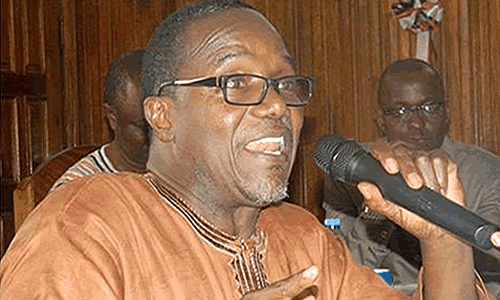
The ongoing debate on whether Liberia should establish a War and Economic Crimes Court has sparked various opinions, with former Senator Commany B. Wesseh proposing a South African-style Truth and Reconciliation Commission as a means of national healing. As a veteran politician and member of the ruling Unity Party, Senator Wesseh believes that the country does not require a war crimes court, citing the Comprehensive Peace Accord signed in Accra, Ghana, in 2003.
Senator Wesseh recalls how witnesses, both Liberians and international signatories, assured the warring factions and the global community that only a Truth and Reconciliation Commission similar to that of South Africa was necessary for national reconciliation. He emphasizes that the 21st anniversary of the peace accord marks a significant milestone and sees no justification for deviating from the agreed-upon path.
Recently, the House of Representatives endorsed a resolution for the establishment of a war and economic crimes court, a move that was met with skepticism by Senator Wesseh. He reiterates that the Comprehensive Peace Agreement deliberated extensively on the possibility of a war crimes court in Liberia or an alternative such as truth and reconciliation. The agreement stipulated the establishment of a Truth and Reconciliation Commission to address impunity issues and provide a platform for victims and perpetrators to share their experiences.
Senator Wesseh cautions against disrupting the peace that has prevailed for over two decades and reiterates the need to address recurring historical issues, such as the events leading to the civil war. He highlights the importance of investigations into unresolved deaths, emphasizing the role of existing legal mechanisms in prosecuting perpetrators. The senator underscores the need for a robust judicial system and law enforcement agencies to ensure accountability and transparency.
While Senator Wesseh’s stance contradicts the push for a war and economic crimes court, especially with international support for such an institution, he advocates for a comprehensive approach to addressing past injustices. The United States, through Ambassador-at-Large for Global Criminal Justice Beth Van Schaack, has been actively promoting the establishment of a war and economic crimes court in Liberia. President Joseph Boakai has also voiced his support for the court, aligning with the recommendations of the Truth and Reconciliation Commission.
Ambassador Van Schaack emphasizes the critical role of citizen engagement in pursuing justice and healing the wounds of the past. She acknowledges that the decision to establish a war and economic crimes court rests with the Liberian people, building on the TRC’s findings. The call to action resonates with the TRC’s advocacy for accountability and the prosecution of war criminals.
As Liberia navigates the complexities of its post-conflict transition, the debate over the establishment of a war and economic crimes court continues. The contrasting views of former Senator Wesseh and proponents of the court reflect the diverse perspectives on transitional justice and reconciliation in the country. Ultimately, the path chosen will shape Liberia’s journey towards lasting peace and reconciliation.
Read the original article on The Newdawn Liberia