Rédaction Africa Links 24 with Kenyans.co.ke
Published on 2024-03-23 15:01:31
In a recent development, President William Ruto of Kenya has announced plans to send 1,000 Kenyan troops to aid troubled Haiti, shedding light on the history of gang violence in the Caribbean nation and the challenges they will face. As Kenya steps up to support efforts to address the crisis in Port-au-Prince and beyond, concerns arise regarding the daunting task of disarming entrenched gangs in Haiti’s volatile landscape.
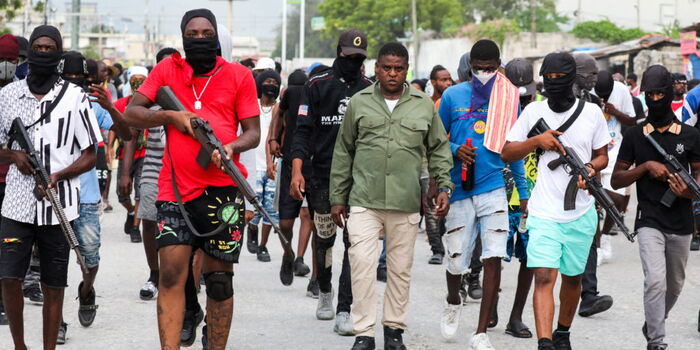
Haiti is home to approximately 200 armed gangs, half of which operate in the capital city of Port-au-Prince. Among these gangs, two major coalitions stand out. The first coalition, known as the G9 Family and Allies Alliance or G9, is led by Jimmy “Barbecue” Cherizier, a former Haitian police officer who is currently under sanctions from the UN and the United States for his involvement in the country’s violence.
The roots of gang violence in Haiti can be traced back to the oppressive regimes that have ruled the nation. From François “Papa Doc” Duvalier’s dictatorship in the 1950s to 1970s, political leaders have utilized gangs for protection and to promote their own agendas, perpetuating a cycle of violence and instability.
Throughout its history, Haiti has experienced multiple instances of direct intervention, including a prolonged US occupation from 1915 to 1934. This occupation, carried out in the name of restoring political stability after the assassination of President Vilbrun Guillaume Sam, resulted in widespread human rights abuses and forced labor practices.
During the Cold War era, the US supported governments aligned with its interests in Haiti, despite allegations of human rights violations. Leaders like François Duvalier received significant financial backing from the US, further complicating the nation’s political landscape.
The assassination of President Jovenel Moïse in 2021 intensified the power vacuum in Haiti, leading to a surge in gang violence and further destabilizing the country. Prime Minister Ariel Henry, who assumed office amidst these challenges, faces accusations of collusion with gangs, hindering his ability to assert authority.
Haiti’s struggle to establish a robust military and an effective police force has exacerbated the difficulties of dealing with well-armed gangs. With an estimated 20,000 to 30,000 gang members compared to a police force of around 15,000, law enforcement finds it challenging to maintain control in gang-dominated areas like G9 led by Jimmy “Barbecue” Chérizier.
Rampant corruption within Haiti’s state structure further complicates efforts to address gang violence. Economic challenges and political instability undermine governance and security provision in the country, creating additional hurdles for law enforcement and government officials.
While international assistance is crucial in tackling the crisis in Haiti, concerns linger regarding the ramifications of foreign intervention and the legality of Kenya’s deployment of troops. Despite domestic opposition to the decision, President Ruto is steadfast in his commitment to sending troops, with some accusing him of seeking personal gain from the crisis.
In response to escalating gang violence in Haiti, the UN Security Council authorized a multinational security support mission, with Kenya at the helm. However, the deployment of soldiers was delayed due to a legal requirement for a reciprocal agreement with Haiti. President Ruto circumvented this obstacle by signing a reciprocal agreement with Haiti, despite the challenges posed by the deteriorating security situation in the country.
In conclusion, the intricate history of gang violence in Haiti, coupled with political instability, corruption, and economic challenges, presents a formidable task for Kenya and other international actors seeking to address the crisis gripping the nation. As President Ruto moves forward with the deployment of Kenyan troops, the world watches closely to see how this intervention will impact the complex dynamics at play in Haiti.
Read the original article on Kenyans.co.ke