Rédaction Africa Links 24 with SudanTribune
Published on 2024-03-28 23:29:49
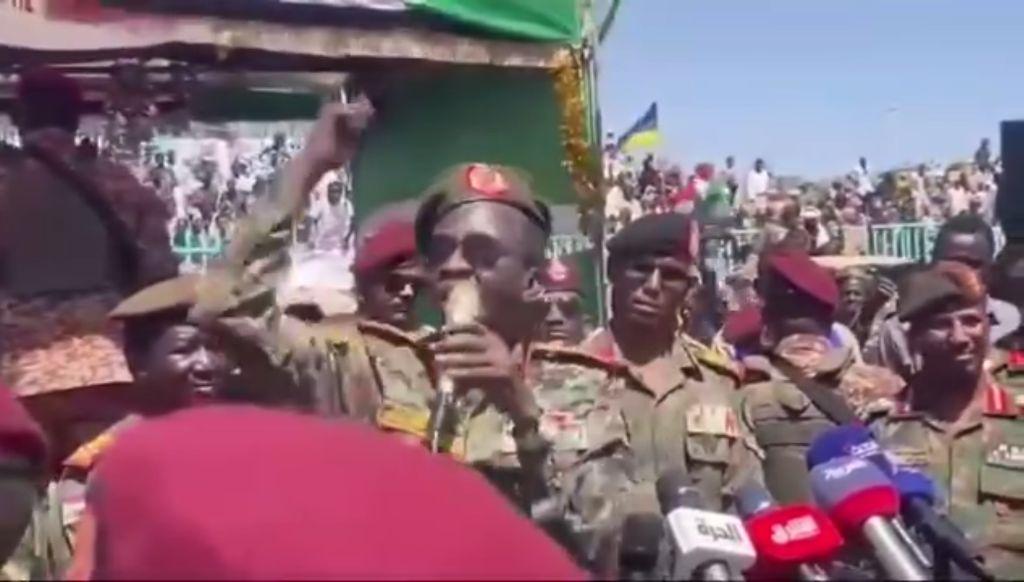
On March 28, 2024, Shams al-Din Kabbashi, Sudan’s Deputy Commander-in-Chief, issued a stern warning to unidentified political forces regarding the exploitation of activities carried out by Popular Resistance groups in conjunction with the army for their own propaganda purposes. The Deputy Commander-in-Chief delivered his message during a ceremony in Gedaref State commemorating the graduation of Sudan Liberation Army-Minawi recruits.
Kabbashi made it clear that Popular Resistance camps should not serve as a platform for political maneuvering. He declared that individuals attempting to push a political agenda within these groups would be barred from entry. He stressed that only the Sudanese flag would be permitted to be displayed within the camps, and he vowed to prevent the raising of any other flags.
Highlighting the necessity of establishing regulations to govern the activities of the Popular Resistance, Kabbashi cautioned that armed civilians operating outside the law could potentially pose a future threat. He announced plans to introduce legislation aimed at exerting control over these groups. The Deputy Commander-in-Chief also instructed military leaders to cease arming civilians outside designated camps and to confiscate any unauthorized weapons found in the possession of civilians outside these camps.
Kabbashi’s statements come in response to the circulation of videos featuring Islamic volunteers fighting alongside the Sudanese army, where they promote the accomplishments of their own militias. Some videos have depicted Islamist fighters engaging in militant chants during training within the camps.
It is worth noting that while various political forces and resistance committees are actively involved in combating the Rapid Support Forces (RSF), they are less inclined to publicize their contributions under the banner of the Sudanese army.
The military leadership of Sudan has expressed willingness to engage in genuine peace initiatives. Kabbashi affirmed support for sincere calls for peace, emphasizing that the army would not cease hostilities or agree to a truce that could potentially be exploited by rebel groups.
Moreover, he reiterated the army’s backing of the Saudi-U.S.-supported Jeddah peace platform, with the stipulation that the RSF withdraws from all urban areas, civilian residences, and facilities before eventually disbanding. Kabbashi underscored the importance of establishing clear mechanisms for ensuring accountability for the actions of the militia and providing compensation for civilian losses.
The Deputy Commander-in-Chief clarified that the military would not be involved in the future governance structure but would contribute to military affairs during the negotiation process. He reaffirmed the army’s refusal to engage in any political dialogue until the conflict had been resolved, expressing confidence in the military’s ability to swiftly bring about a resolution to the conflict. He urged all political and civilian factions to collaborate on drafting a document to govern the country.
Kabbashi also expressed the military’s willingness to participate in an investigation into the root causes of the conflict, contingent upon a thorough and comprehensive inquiry. He argued that despite efforts to de-escalate tensions, the underlying grievances had ultimately led to the outbreak of hostilities.
Characterizing the ongoing conflict as a “war orchestrated by the Rapid Support Forces through the use of mercenaries,” Kabbashi emphasized that aligning with the Sudanese army signified alignment with the official and legal entity tasked with safeguarding the nation’s interests.
Read the original article on Sudan Tribune