Rédaction Africa Links 24 with Bella Diallo
Published on 2024-03-08 21:07:08
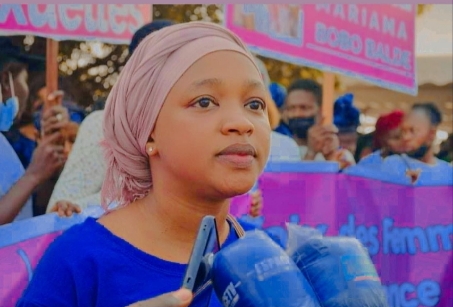
http://Actuguinee.org / Humanity celebrated International Women’s Day on Friday, March 8, 2024. In Guinea, this day is focused on the theme “Investing in Equality of Opportunities”. To discuss this day and certain aspects of women’s rights, Actuguinee interviewed Fatoumata Diaraye Bah, a human rights and women’s rights activist, and General Secretary of Amnesty International Guinea. In a candid interview, the president of the NGO Women Hope Guinea dissected the situation regarding the respect of women’s rights in Guinea and made recommendations for their effective implementation. Interview:
Actuguinee.org: What does March 8th represent to you?
Fatoumata Diaraye Bah: Like all women around the world, this day represents a day of action, advocacy, and assessments in regards to women’s rights. For several years now, the United Nations has designated this day as International Women’s Rights Day, celebrated worldwide to commemorate the actions taken by our predecessors in support of girls’ and women’s rights. Therefore, this day is a day of action, advocacy, and assessment to determine the progress made and the challenges remaining in upholding women’s rights worldwide.
Actuguinee.org: What is your view on the respect of women’s rights in Guinea?
Fatoumata Diaraye Bah: There is a lot to be done. Today, if we look at the state level, while there are laws inspired by international conventions on women’s rights incorporated into our laws to respect the rights of girls and women, the practice is the issue. Progress in the respect of women’s rights should be measured by that girl or young woman in Yomou. Does she have access to education, to healthcare (…)? Today, there are many organizations in our country working with the help of technical and financial partners in collaboration with the government and state institutions to take actions or advocate for the respect of girls’ and women’s rights. However, there are significant challenges when it comes to these issues, and this is prevalent everywhere. Despite efforts made, challenges still exist in areas such as education, healthcare, and gender-based violence in general. We have seen girls who have been victims of domestic violence, physical abuse, and psychological abuse throughout the country, so it remains a challenge despite the efforts invested in this regard.
Actuguinee.org: What do you do concretely to respect women’s rights in Guinea?
Fatoumata Diaraye Bah: March 8th is every day of the year, it is every day, every second, every minute that God creates, we must work for the respect of women’s rights. We cannot act everywhere and at all times, we are limited in our means. Certainly, we are supported by well-meaning individuals or advocates for women’s rights, but each at the grassroots level, tries to do what one can (…). So, what we can do is raise awareness, provide training, and information on the rights of girls and women because we believe that a person who is not educated or informed about their rights cannot know and cannot demand their rights. Therefore, we try to do what we can with our resources and collaborate with organizations working in this direction to bring about change because, alone we can go fast, but together we can go further and faster. In life, nothing is easy, so I do my best to bring about change, no matter how small it may be everywhere I go. A small action just to change something is better than sitting idle and waiting for others to change things. So, whatever I can do to advance the fight, I do it.
Actuguinee.org: What difficulties do you encounter in your advocacy and how do you manage to overcome them?
Fatoumata Diaraye Bah: We are sometimes confronted with customs and traditions that do not directly support the rights of girls and women. We are not saying that our customs and traditions are bad, but sometimes, there are barriers, miscommunications that do not promote the respect of women’s rights. So often, as an activist when you start using a certain language that pertains to women’s rights, you are labeled with all sorts of names and at some point, you face difficulties. But we try to adopt certain behaviors to make ourselves understood. Therefore, this is why the fight for women’s rights must start at the grassroots level (…) Men alone cannot do everything, we must fight together, that’s why this fight must be led with men.
Actuguinee.org: What are your recommendations for ensuring women’s rights are respected in Guinea?
Fatoumata Diaraye Bah: My recommendations extend to various areas as responsibilities are shared. At the family level, everyone should be involved in upholding women’s rights at all levels. To the State, instead of organizing celebrations and going dancing and singing, I recommend the Ministry [of Women’s Promotion, Children, and Vulnerable Persons] to organize meetings on this day to discuss women’s rights and try to assess the level of respect for women’s rights and collectively discuss key issues concerning girls and women, and perhaps, at the end of the day, create a document and provide recommendations based on the laws passed to find solutions to all problems. To human rights organizations in general, it is about coming together, showing solidarity, not going in different directions because we have the same concerns, the same fight, it is our role as NGOs and civil society. So, we are not enemies, we are not adversaries with the State, we are there to complement, to lend a helping hand because the State alone cannot succeed, we must work together. To girls and women, they must stand up to fight and demand their rights because if we know our rights, no one can violate them. To the judiciary, even though it is part of the State, we urge it to deliver justice to victims.
Read more revelations quickly here http://Actuguinee.org
Read the original article(French) on Actu Guinea