Rédaction Africa Links 24 with Roxanne Bouenguidi
Published on 2024-03-18 23:02:19
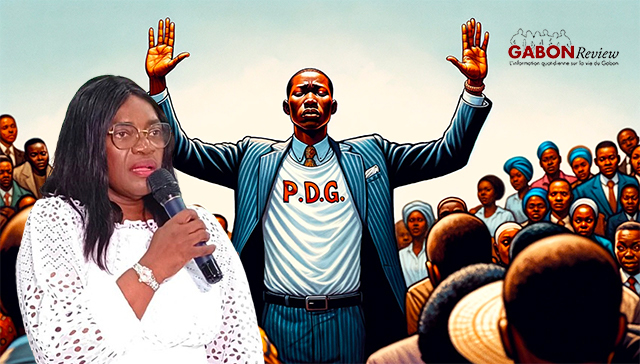
The apology addressed to the people by the Gabonese Democratic Party (PDG) seems like a formality.
It is the latest communication strategy at the Gabonese Democratic Party (PDG): an apology addressed to the people, but formulated within a strictly partisan framework. Inaugurated by the new general secretary, this method was later adopted by other personalities during the “Self-Criticism and Refoundation Conference” held last weekend in Libreville. In other words, without listing the facts or specifying the dates of their commission, let alone identifying the perpetrators or consulting the victims, the members of the self-proclaimed leadership of the PDG advocate for a collective amnesia, synonymous with social forgetting and legal absolution. As expected, this initiative has sparked anger and disapproval among a large part of public opinion. As a result, some are calling for the establishment of a transitional justice mechanism in line with universally accepted principles. More impulsive individuals are calling for the outright dissolution of the former single party.
Shedding light on the past
Obviously, the PDG seems to have embraced the idea of social reconstruction based on a poorly defined moral principle: forgiveness. However, its leadership does not elaborate further, leaving the impression of fulfilling a formality. Are they ready to shed light on the past? For acts of what nature? Financial crimes, abuses motivated by the desire to stay in power, or both at the same time? Which period would be covered? The last five years, the entire Ali Bongo era, the post-national conference period, or the entirety of the PDG’s reign? Are they willing to be held accountable for their actions before impartial courts, even if they later seek amnesty? Or do they want to promote impunity? Do they acknowledge that victims have the right not to grant them this forgiveness? On all these questions, the new hierarchs of the PDG remain silent, content to proclaim their remorse without going further. Have they even thought about the implications of their initiative? Have they fully grasped it? It is hard to believe.
If it can lead to the rehabilitation of victims and perpetrators, the request for forgiveness is part of a triptych including truth and justice. Otherwise, it can become counterproductive. How much credibility can be given to a request made almost mechanically, half-heartedly, and without enumerating specific reasons? As seen in Tunisia after the fall of Ben Ali, the request for forgiveness is neither an end in itself nor an incantation. Focused on the victims, it can be accepted or rejected. Moreover, it generally entails reparations, both financial and moral. If the PDG believes it can easily settle the past, it must realize that nowhere in the world has forgiveness been decreed unilaterally. Everywhere, it has been the result of a process involving all parties.
Muddying the waters
Nevertheless, the PDG acts as if it could be otherwise. Having never reprogrammed its software, it has always behaved like a single party, disregarding laws, regulations, or procedures to submit institutions to the will of its leaders alone. Blinded by the illusion of omnipotence, its elites have acted as if on conquered territory, indulging in all sorts of harassment towards other citizens. Lured by easy gain, they have maintained opacity to better seize public money and, more broadly, conceal all their wrongdoings. Therefore, it is difficult to know who they are referring to by showing contrition. Are they addressing the State, long deprived? Or the people, deprived of their fundamental rights? For which specific events? It would be good to know.
Unless an independent investigation is opened for a specific period, a request for forgiveness seems either premature or intended to muddy the waters. Are the members of the PDG’s steering committee willing to play along? While they can be implicitly commended for confessing, while they can be acknowledged for inadvertently supporting the idea of a transitional justice mechanism, one wonders if they are ready to fully commit to their thoughts. For now, their request seems poorly developed or even malicious: without prior truth or justice, it will always appear as a simple political maneuver.
Read the original article(French) on Gabon Review


