Rédaction Africa Links 24 with Roxanne Bouenguidi
Published on 2024-02-26 11:31:43
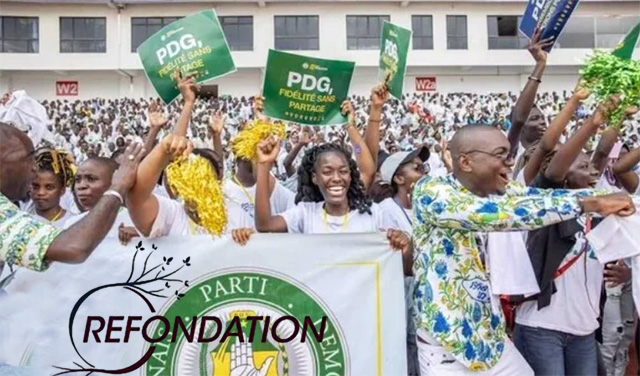
The Gabonese Democratic Party (PDG) says it wants to “propose solutions for the future”. How much value should be given to this announcement?
For the past six months, the Gabonese Democratic Party (PDG) has refused to engage in any introspection, acting as if the August 30 coup says nothing about its governance, as if it is not responsible, as if Ali Bongo was not deposed but replaced. Riding on the leniency of the Committee for the Transition and Restoration of Institutions (CTRI), its leaders boast, proclaiming that they have a “sense of duty fulfilled”. Satisfied with their presence in the new institutions, its executives feel entitled to continue as before, boasting about their alleged “experience”. Swept away by a sense of impunity, its base feels immune to any setbacks, announcing an imminent return to power. Unexpectedly, in recent days, things have taken a different turn, with the interim Secretary General of the PDG convening “Assises d’autocritique et de refondation”, supposed to “identify errors of the past”.
Accomplished Fact
One can acknowledge the PDG’s willingness to amend its ways or contribute to inventing the future. But, what value should be given to this “self-criticism” announcement? Less than two months ago, Luc Oyoubi was in complete denial, stating: “The PDG did not manage the country, even if its militants were often the first responsible”. Sure of his stance, he added: “The PDG (…) advocates dialogue, tolerance, peace, loyalty, reconciliation, solidarity, unity, responsibility, humility, merit, participation, and gathering to promote the development of our nation”. Is he sincere when he contradicts his recent statements? Is he not attempting a maneuver either to give himself credibility or to confront his fellow party members with a fait accompli? How can one speak of “refoundation” when we know how much this concept has been worn out in the recent past without tangible results? How can one achieve “refoundation” when personalities like the President of the Transitional National Assembly refuse to undergo an intellectual revolution, to the point of labeling other actors of the Transition as “the opposition” or presenting the President of the Transition as a “regime” figure considered neutral due to his “military” status? How can one conceive of “refoundation” when the last three political offers of the PDG suffer from a deficit of internal appropriation since they were formulated by international consulting firms? How can one envision “refoundation” when certain initiatives continue to have perverse effects, as evidenced by the denunciation of the fusion-absorption process by the Gabonese Social Democrats (SDG)?
Informal Character of the Interim
The legality of these “Assises d’autocritique et de refondation” is not established either. First, due to the informal nature of the interim: according to article 56 of the PDG’s statutes, the interim should have been designated by either the secretary general or the president. However, it is well known that both of them are in uncomfortable situations and, therefore, were unable to provide authorization. Secondly, due to the non-existence of the relevant body: not being akin to the national council, political bureau, or permanent political bureau committee, let alone the congress, this meeting does not hold any juridical value. Finally, due to the absence of the president: statutorily in charge of directing “all central, deliberative, and consultative bodies,” he is the only one authorized to guide activities, ensure respect for the ideals, values, and line of the PDG. On what legal basis does Luc Oyoubi grant himself these powers? A mystery. For now, any dissatisfied member is legally entitled to express their disagreement.
The PDG announces “Assises d’autocritique et de refondation”. It claims to want to “propose solutions for the future”. Ultimately, it is a last-ditch effort undertaken not for the common good or the interest of the country, but to ensure the political survival of a few. One must acknowledge Luc Oyoubi and his cohorts the right to maneuver. But, one cannot support them without confronting them with their past or recent excesses and cowardice. One cannot watch them twist all norms and procedures, even if they are internal. After all, like all political parties, the PDG is “a nonprofit association established to participate in the management of public affairs”. Theoretically, it receives public funding. For these reasons alone, every citizen is justified in demanding that it abide by the laws of the Republic, as well as its own regulations.
Read the original article(French) on Gabon Review