Rédaction Africa Links 24 with La Rédaction
Published on 2024-03-03 17:51:03
The abundance of public investments in certain provinces, especially in northern Gabon since the CTRI came to power, revives the debate on regional inequalities. Some internet users are no longer hesitant to demand the establishment of a “rotating presidency” to guarantee an equitable distribution of national wealth.
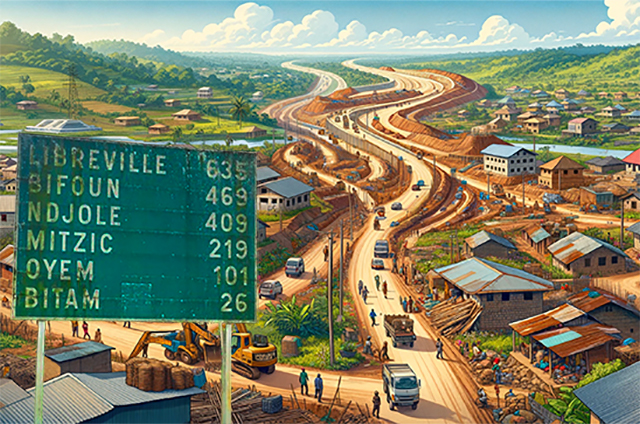
Image for illustrative purposes only. © GabonReview
“We saw all the generosity of Oligui in favor of Oyem during his last visit to his ‘parents’ and today we see the kindness of his wife on her lands in Lebamba. If this is not a ‘creeping injustice,’ it certainly looks like it,” one could read in a large Facebook discussion group. A post that sparked a lively controversy between CTRI supporters and others who consider themselves lucid.
This debate revolved around governance and local development: should we advocate for the adoption of the principle of “rotating Presidency” by province… for an equitable distribution of national wealth? At first glance, the idea may seem superfluous. But all in all, it is not lacking in relevance and interest in view of the management, actions, and governance practices tainted by favoritism and clientelism – against a backdrop of identity politics – that characterize the leadership at the top of the State, from the Bongos (father and son) to the present day, all proportions considered.
It seems that during all these decades and still today, the work of building a Nation dreamed of by the Founding Fathers was nothing more than a vain abstraction. And beyond the lofty speeches, the observation that emerges since the era of the Bongos is that some regions of the country have been and others will cyclically be favored, depending on changes at the top of the State.
Robbing Peter to pay Paul
One only needs to observe the volume of public investments and the number of projects initiated, in a short period of time (6 months), to question the timing and the choice of the Septentrion province – notably its capital and its surroundings – to understand that the center of gravity seems to have shifted.
If in the past, no major project could be conceived and implemented without impacting the Southeast region of the country, today the focal point of priority socio-collective infrastructure works is located in the Septentrion, especially in the Woleu region.
The development lag to catch up on in this part of the country is undoubtedly the reason for all the current efforts being deployed there, including the provision of a significant fleet of vehicles for urban public transport, the rehabilitation and delivery of the Ewotmekok airport, as well as the implementation of urban road construction projects, markets, and a municipal cemetery…
We will await the various budget plans for the progressive implementation of similar projects, and to the same extent, in the rest of the country; except for the southern Ngounié region, with its epicenter in Lébamba, where echoes of generosity and benevolence from the new authorities have also been heard in the past two weeks. There were important figures present.
Upholding equity and social justice
Undoubtedly, today more than ever, the populations show unconditional support for their leaders, following the spontaneously celebrated “liberation coup” by all. However, they expect a fair return through governance practices that definitively break with the concepts of “charity begins at home,” which have fostered numerous discriminations and divisions.
Certainly, the wounds are still gaping enough to strongly call into question those who have had the grace to be entrusted with the responsibility to successfully carry out the tasks of restoration and living together. Peace, cohesion, and social justice are at stake.
Amour Freez Kendrick
Related Articles
Read the original article(French) on Gabon Review