Rédaction Africa Links 24 with Désiré-Clitandre Dzonteu
Published on 2024-03-12 16:02:09
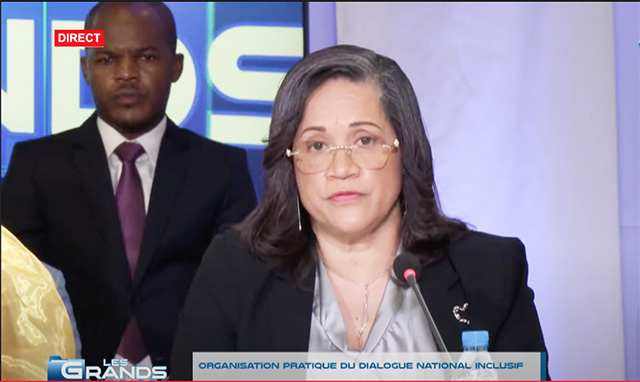
Less than three weeks before the opening of the Inclusive National Dialogue, the Minister of Institutional Reform, Murielle Minkoué-Mintsa, was invited to the program “Les Grands Dossiers” on Gabon Première on March 10. Facing the duo of journalists Rodolphe Moukambi Boma and Wivine Abessolo, she took stock of the activities of this strategic department of the Transition, but above all shed light on the upcoming national conference in order to dispel misunderstandings. This is particularly important as voices are rising and criticizing the “opaque organization”.
The timetable for the Inclusive National Dialogue, a large-scale national consultation announced from April 1 to April 30, 2024, recently published in the Official Journal, had the Minister of Institutional Reform in the Transition government, Murielle Minkoué-Mintsa, on the set of Gabon Première. As a guest on the program “Les Grands Dossiers”, she outlined the main axes of this meeting which aims to “rethink, reshape, revitalize, reform, and restart the Gabonese machine”. However, some discordant voices have criticized the lack of transparency surrounding this national event. She provided clarifications on all concerns.
“Other dialogues were purely political”
Comparing the upcoming National Dialogue with past meetings, the Minister of Institutional Reform indicates that “if there was the intervention of the defense and security forces on August 30, it was because things were not working anymore and we were on the brink of an explosion. We were afraid of what would happen once we received the results of last year’s elections.”
“But apart from the National Conference of 1990, which came after the students’ surge of anger, I was one of those students who said no, we can no longer continue to learn in these conditions, and it gained momentum, it snowballed and we arrived at the Conference of ’90, hence the 1991 Constitution,” she recalled before noting that in the meantime, other dialogues were purely political.
For her, it was the majority calling the opposition, and in the opposition, some accepted to come, and others not at all. For the head of the department in charge of Institutional Reform, it was a game. “I see it as a game. On August 30, the military said no. Enough!” she pointed out.
“Our entire coexistence will be represented at the Dialogue”. “We are putting in every effort to ensure there are no missteps,”
Regarding the upcoming Dialogue, Murielle Minkoué-Mintsa explains that through the “Mbova” application, the servers recorded contributions from 25,943 individuals and 6,606 legal entities (associations, political parties, institutions, etc.). All this for more than 38,000 contributions, even though some have not yet been integrated into the platform.
As for the alleged lack of transparency surrounding the organization of these meetings, she responded by saying that the responsibilities of the Ministry of Institutional Reform, as outlined in Decree 52 issued on November 21, are clear. “The organization of the national consultation is an exclusive responsibility of the Ministry of Reform. It is on this basis that we are preparing the National Dialogue. We are not organizing the event. We are preparing, we are putting in place all the necessary tools to facilitate the work of the Dialogue, which will be chaired by the Archbishop of Libreville, Archbishop Iba-ba,” explained Madame Minkoué-Mintsa.
She also points out that the head of the Transition has been clear in his timetable and the National Dialogue concerns all socio-professional categories in the country. “Our entire coexistence will be represented at the Dialogue,” she reassured.
“The purpose is not to distribute per diems. The purpose is to bring together compatriots and debate”
However, she notes that it was not possible to organize meetings with 38,000 people. The National Dialogue is a stage of the Transition. It is enclosed in time, the month of April. “We are putting in every effort to ensure there are no missteps,” she said.
The issue of per diems was also addressed, and Madame Minkoué-Mintsa informed that the organizers of the Dialogue, namely the CTRI and the government, will decide. “You know, if we do not reinvent the wheel, we do not have the vocation to distribute. The purpose is not to distribute per diems. The purpose is to bring together compatriots for nearly a month and debate,” she explained.
She also remarked that “in all organizations, internationally or elsewhere, when you bring people together, there may be a little something. It is not a reward because of the work they will carry out, and beyond that… and I cannot affirm that there will be per diems, the President of the Transition will decide on that. If there are, I hope those who do not want them will refuse to take them, and then the public treasury will potentially recover them or they will be redeployed, because there is the Constituent Assembly to be set up. The state could eventually, using authorized mechanisms, redirect these amounts towards other objectives.”
Call for the conscience and responsibility of all, to think about the future of our country
To conclude this exchange, the Minister of Institutional Reform called for the conscience and responsibility of all those who will have the opportunity to work together for the future of Gabon. “It is up to us, the Gabonese,” she emphasized.
“We did not use tools from the outside. We did not call for help to contribute, to exploit, to prepare for the Dialogue. For this stage, let us continue to show the image of the Gabonese as he is and as we all appreciate; that is to say, someone who loves his country and is ready to give his all for his country,” added Murielle Minkoué-Mintsa.
She finally believes that “the Gabonese have the opportunity, a rare opportunity presented by history, to express themselves and think about the future of our country independently and responsibly.”
Read the original article(French) on Gabon Review