Rédaction Africa Links 24 with Roxanne Bouenguidi
Published on 2024-03-15 10:21:56
The self-proclaimed leaders of the Gabonese Democratic Party (PDG) can hardly imagine themselves far from the decision-making spheres, the woodwork, and the gilding of the Republic. Is it sincere to declare noble ambitions after violating the statutes of one’s party to take control?
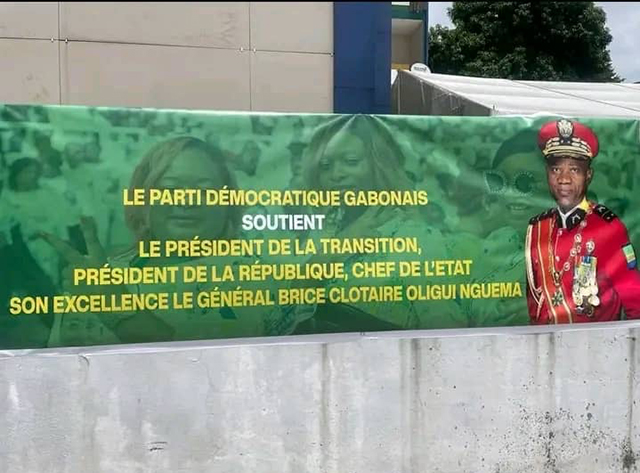
“Despite the deserters, traitors, and false friends, the Gabonese Democratic Party (PDG) is still standing,” Ali Bongo declared in December 2017, during the closing of the 11th ordinary congress of his political party. Nearly seven years later, his former followers celebrated the 56th anniversary of their party without him, after cavalierly dismissing him. Far from any ethical or moral consideration, they were quick to pledge allegiance to his successor, proclaiming their support for the Committee for Transition and Restoration of Institutions (CTRI). “Indecent,” “shameful,” “cowardly,” react many observers. From these unequivocal judgments, there emerges frustration, anger, but also doubts among a certain opinion, annoyed by so many breaches of public virtue.
By conformity, by calculation, or by fear
Indeed, the PDG has never been dissolved. Indeed, it still enjoys legal recognition. Indeed, it still has the freedom to carry out its activities or to support the person of its choice. But its leaders cannot continue to take liberties with the texts, including those governing their party. They cannot pretend that the coup of August 30th last year did not reflect on their management. It displeases them, but their responsibility, individual or collective, is implicated in the current maelstrom. Beyond the struggles for positioning, they must keep in mind: even if the CTRI shows magnanimity towards them, it has also acted to render them powerless. And their new Secretary General’s apologies will change nothing: having acknowledged a deficit in listening, Angélique Ngoma did the bare minimum, refraining from mentioning the confiscation of popular vote, the usurpation of national sovereignty, the denial of human rights, and the breaches of duty carried out by her colleagues.
If they have shown willful amnesia, cynicism, cowardice, and unparalleled opportunism, the self-proclaimed leaders of the PDG have not surprised many. Militants with winding paths or rectilinear trajectories, they did not join by choice or conviction. They did so by conformity, calculation, or fear, their goal being to reap some perks or more. Therefore, they can hardly imagine themselves far from the decision-making spheres, the woodwork, and the gilding of the Republic. Accustomed to undue privileges and special favors, they are ready to do anything to retain them, even engaging in all transgressions. Their commitments to the necessity of reconciling “with (their) compatriots,” to work for the “reconstruction of the country,” or to promote “efficiency in managing affairs”? In many ears, they sound like sirens’ songs. How sincere can one be when proclaiming noble ambitions after violating the statutes of their party to take control?
Aversion to principles
As Francis Nkea Ndzigué, former minister and member of the Political Bureau of the PDG, rightfully points out, “only the congress can proceed with the modification by electing members of the executive secretariat.” Furthermore, if the president has this competence between two congresses, Ali Bongo could not do so as he is virtually “deposed from his function.” Therefore, “it is unknown on what legal basis the new PDG organizational chart was conceived.” By evolving outside the statutes, the self-proclaimed PDG directorate provided further proof of its aversion to principles. By deeming the ousted president unfit after stating the opposite a few months earlier, it prioritized partisan interests over national interests, personal considerations over the collective purpose. Given their initial commitments, can the CTRI accommodate such support? Does it really need it?
In politics, nothing is set in stone. However, unless lacking an ideological foundation, certain things are unthinkable. Hence the need to be clear about moral values, ideas, the conception of the world, or principles. However, having always defined itself as “a mass party,” the PDG is actually a catch-all party, capable of supporting diametrically opposed opinions. Is this ideal during a period of institutional restoration? One may doubt it. On the other hand, it can be urged to revisit history and reflect on its relationship with the rule of law and others, with detachment and rigor. For itself, for the Transition, and for the country, it will always be a step forward.
Read the original article(French) on Gabon Review