Rédaction Africa Links 24 with Miguel González López
Published on 2024-03-29 04:30:00
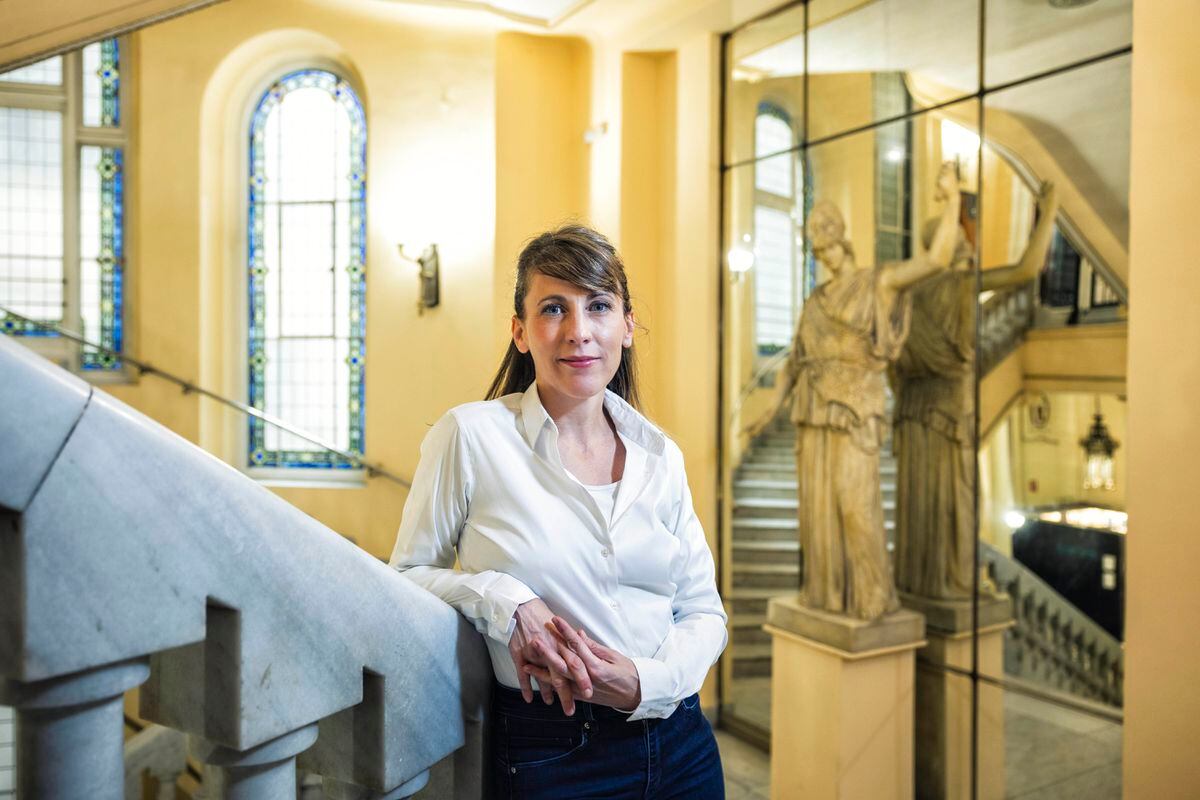
Of all the warlike devices that appear in Inés González Lozano’s first novel, “Hilos de Hierro,” the most fearsome is the mirror weapon: enemies are paralyzed when they see the scene of their own death. “The naked truth is an irresistible weapon, knowing your destiny is a condemnation,” reflects the author. “That is why the mantics [seers] have deformed faces. Raw reality is unattractive.” Her book is the rigorously documented and scrupulously faithful story of a non-existent republic in an imaginary geography.
Question. In your work, there is a madman without a shadow who takes his stigma as a prize. What he says reminds of the lyrics of the children’s song “Vamos a contar mentiras” and when he asks the protagonist if he wants to hear his life story, he answers: “The true one or a lie?” Tell me yours.
Answer. I was born in Madrid 47 years ago, I am an only child, and I have a daughter. My parents were labor lawyers and members of the PCE. My mother was pregnant with me when the Atocha massacre occurred. One of the wounded, Lola González Ruiz, was her close friend. Another survivor, Luis Ramos, was my teacher in Law.
Q. Then you married a diplomat and went to Equatorial Guinea. There you could not defend workers in court…
A. I ruled it out to avoid a conflict of interest, but I set up an NGO with women from a shantytown who made bags and sold them. The brother of one of them was very ill, and they asked me to help him, although I couldn’t go see him because they said that being white with long hair, they would take me for a mermaid who came to harm him. So I gave them an infusion called “Carmencita Buenas Noches.” Two days later, they came back shouting “miracle! miracle!” and asked me to give it to them because white people’s medicines are better. I spent the whole day preparing infusions and felt like a swindler.
Q. Your book is full of herbal remedies…
A. They are all in the Hippocratic treaties and ancient medical texts, just like the dream cures from the Greek sanctuary of Asclepius.
Q. In your novel, as in Guinea, medicine and magic, superstition, and science are mixed…
A. In ancient Rome, which inspires me, there was an official religion, in which people believed but less, and another popular one to solve everyday problems by appealing to supernatural powers. Tablets with curses, spells, or incantations have been found.
Q. There is also a trial, in which you must have poured your lawyer profession, and a corruption scandal.
A. My father’s name was Cristóbal, but my mother called him “Tobal,” and the lawyer in the book, the one who defends the poor potter, is called Tobalano. Corruption seems very current, but in Rome, it was commonplace. Grain was subsidized by the State, and when a rotten batch arrived, there were debates in the Senate and riots. My father died while writing the novel, and maybe that’s why it turned out sadder than I had thought.
Q. You talk about moons with 30 nights, rivers flowing from the sea to the earth, floating forests, and women who lead the Army.
A. I wanted women to be able to be warriors, something that didn’t happen in Rome and even less in Greece. A novel is a lie that the reader is willing to believe, suspending their disbelief. What the writer demands is not that the story is real but true.
Q. One gets lost in the interplay between reality and fiction. It is not even easy to distinguish which words are archaic and which ones are invented.
A. I am a bit of an advocate for lies, although as a journalist, you might disagree. Always going with the truth ahead, the truth even if the world perishes, is a bit cruel. The lie does not heal you, but in some moments, it can alleviate the pain, as long as you know how to control it. The lie can be a painkiller, and truth, surgery without anesthesia.
Postscript. When I get home, I find a message from her: “Something I told you is not true.”
Please note that the translation above may not be perfect, as some nuances of the original text may be lost in translation.
Read the original article(Spanish) on EL Pais