Rédaction Africa Links 24 with Florine Mouano
Published on 2024-04-04 09:48:42
This decision will allow the justice to continue its investigation into the case against the deputy of the first electoral district of Moungali.
Lifting of parliamentary immunity for deputy Aimé Hydevert Mouagni. The president of the Commission on Legal and Administrative Affairs, Decentralization, and Control of Law Enforcement, Benoît Bâti, announced on April 3 in Brazzaville that the decision will allow their colleague to prepare his defense.
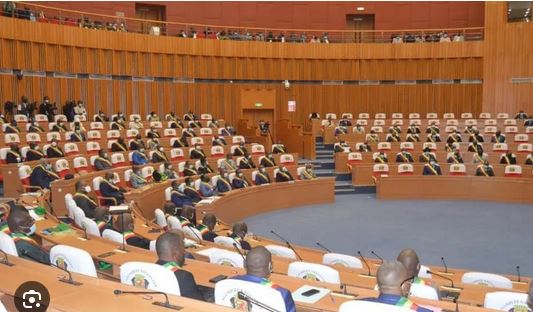
“The National Assembly cannot block the justice system from pursuing the procedure against deputy Aimé Hydevert Mouagni. This will also allow our colleague to have the opportunity to build his defense. We are not in the phase of a conviction but in the procedure, as our colleague is still presumed innocent,” said Benoît Bâti during the plenary session of the National Assembly that lifted the parliamentary immunity of Aimé Hydevert Mouagni.
104 out of a total of 107 deputies voted to lift the immunity of Aimé Hydevert Mouagni, two abstained, and one voted against.
For the Minister of Justice, Ange Aimé Wilfrid Bininga, lifting parliamentary immunity allows the High Court of Justice to judge Deputy Mouagni like an ordinary citizen.
“The lifting of immunity does not mean that he is no longer a deputy. He can always come back among us,” specified Isidore Mvouba, President of the National Assembly.
For Claudine Munari, this lifting was not necessary. “I listened to the audios and I did not hear any statements that could justify lifting his immunity. We all complain about the difficulties we encounter in this country. These are problems that we all know. It was a person speaking with an acquaintance.”
The National Assembly was approached by the Prosecutor General at the High Court of Justice to seek authorization to prosecute Deputy Aimé Hydevert Mouagni.
It is reminded that Aimé Hydevert Mouagni is accused of making statements that could constitute offenses of compromising national security by disclosing information that should be kept secret, illegal possession of war weapons, and dissemination of false information containing defamatory allegations.
Read the original article(French) on Journal de Brazza