Rédaction Africa Links 24 with Pierre Tahingam
Published on 2024-04-03 16:35:49
Twenty experts and researchers gathered in Yaoundé have expressed a favorable opinion for revising the inflation target from 8 to 9% against the current 3% in the Franc zone.
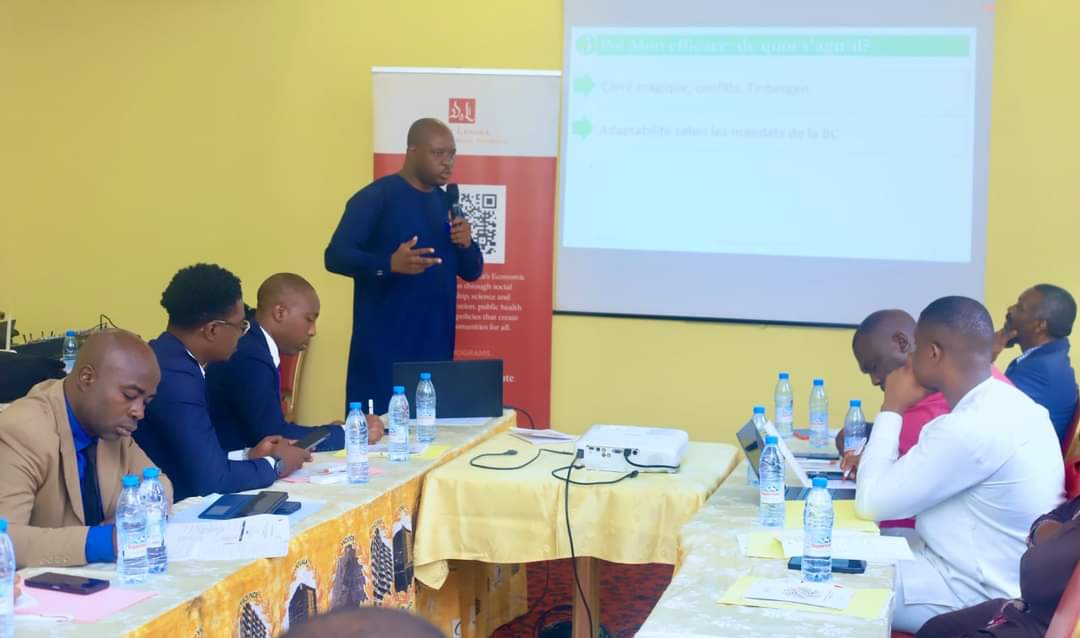
For three hours, the stakeholders debated under the theme: “Reflecting on evidence-based economic policy recommendations to improve the effectiveness of monetary policy in Francophone Africa.” This working session was initiated by the Nkafu Policy Institute, the think tank of the Denis and Lenora Foretia Foundation. It highlights the challenges facing economies in the Franc zone and proposes ways to strengthen the effectiveness of monetary policy in countries that use this currency.
According to economist Jean Cédric Kouam, several studies show that monetary policy faces certain limitations. These include the inoperability of transmission mechanisms, low banking rates, which means that monetary policy decisions do not affect the real economy. “For example, several studies have demonstrated that the 3% inflation rate is no longer compatible with our economies and that an inflation targeting of 8 to 9% should be set,” notes the researcher from the Nkafu Policy Institute. He urges policymakers to take into account research results based on evidence and facts.
Professor Dieudonné Mignamissi, a lecturer at the Faculty of Economic Sciences and Management at the University of Yaoundé 2, Soa, proposes some essential prerequisites for the effectiveness of monetary policy in the Franc zone. According to the academic, the first prerequisite is the institution ‘the Central Bank’, which embodies monetary policy. “It must be independent, make decisions based on the direction of its fundamental strategies without being influenced by the political environment,” recommends Dieudonné Mignamissi. Another strategy for effectiveness is to “consider expanding the range of strategies or objectives with new instruments of monetary policy, especially unconventional instruments in times of crisis.”
“Overall, if the Central Bank subscribes to these requirements, we could have an effective monetary policy. Not to forget the regular effort of communication to make its actions credible and transparent,” adds the lecturer.
Professor Dieudonné Mignamissi also touches on the role of states and central banks in making monetary policy effective. Here he wishes for each entity to stay in its lane. The Central Bank is responsible for monetary policy and budgetary policies fall back to the states.
For this connection to be relevant, the academic notes that in a monetary union, countries must look in the same direction. Despite some problems of credibility and debt, which sometimes create inconsistencies with the Central Bank, states in the Franc zone need to align their views. In the Francophone zone, the two monetary unions are in Central Africa, the Economic and Monetary Community of Central African States (CEMAC) and in West Africa, the West African Economic and Monetary Union (UEMOA). Both use the CFA Franc.
Participants also highlighted during the discussion that the central banks in the Franc zone face a number of structural and cyclical constraints. They urge decision-makers to move towards greater autonomy by distancing themselves more from this colonial supervision. Stakeholders suggest that for central banks to have the best effect in terms of monetary policy, they should take into account the demands of the population through government policies at the national level.
Dr. Charles Owona emphasizes the importance of better coordination between states and central banks for increased effectiveness. He emphasizes the need for convergent community policies and synergy of action between states and central banks to improve the effectiveness of monetary policies.
Read the original article(French) on Journal du Cameroun