Rédaction Africa Links 24 with Khalil JELASSI
Published on 2024-04-12 10:53:38
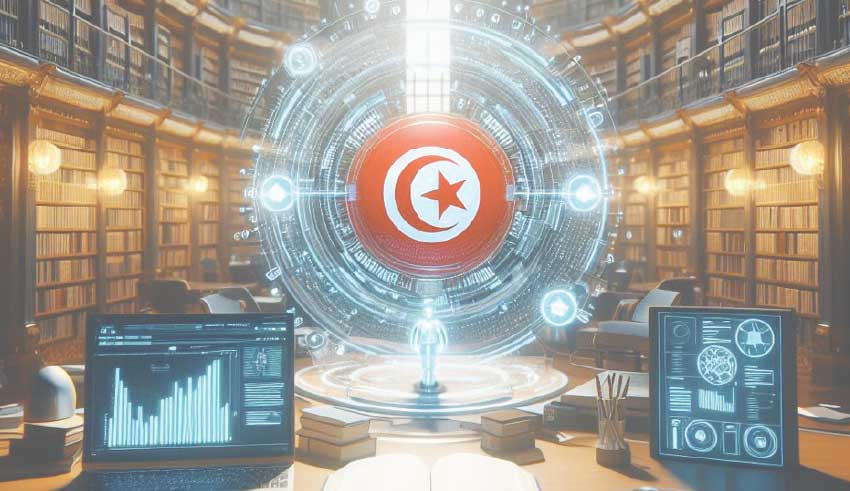
Tunisia is among the first Arab and African countries to launch artificial intelligence projects, but is currently lagging behind due to lack of resources ©Photo Ai created by La Presse
Faced with the spectacular acceleration of AI development, Tunisia, despite its limited means, is trying to establish itself in the fields of regulation, research, and innovation. Time is of the essence!
Artificial Intelligence (AI) is gaining ground worldwide. All sectors are affected, from information and big data to people’s daily lives. Tunisia is not isolated from this global context, which seems to be subject to the increasingly powerful influence of AI. Between sometimes hesitant and mistrustful speeches, sometimes awed by the technology, experts agree that artificial intelligence can be an opportunity for Tunisia if well regulated.
In this context, the Ministry of Higher Education and Scientific Research is preparing to launch the first interactive library driven by artificial intelligence. The tool is dedicated to students in Tunisia and abroad, academics, and researchers and is designed and funded by 100% Tunisian expertise. The department has received a new computer with exceptional capabilities in Tunisia to carry out this unprecedented project.
According to the ministry, “Elm” offers a wide range of content tailored to the needs of Tunisians. The documents, books, and various materials are regularly updated thanks to the achievements of AI. The platform is technically capable of hosting over a million books and documents, and a million visitors at the same time.
For national incentive programs
If projects like this can represent a starting point to optimize the use of these rapidly advancing technologies worldwide, a strategic vision and a national plan are essential. Indeed, many countries have launched national incentive programs, as well as frameworks for its practices. These countries are rushing to establish legal frameworks and suitable economic and digital ecosystems to embark on this experience. In Tunisia, there is a delay in adopting these technologies despite enormous potential, especially in terms of human resources and skills. How can Tunisia take advantage of this incredible global ecosystem that is beginning to emerge despite limited financial resources and the technological dominance exercised, in fact, by Western countries?
Dr. Khaled Ghedira, an expert in artificial intelligence, contacted by our newspaper, explains: “Work in this field officially began in Tunisia in 2005 with the creation of the Tunisian Organization of Artificial Intelligence, but this field began to be effectively addressed since 1986, when an awareness seminar was organized at the Faculty of Sciences in Tunis by a group of university professors. Between 2000 and 2002, a number of faculties, especially engineering schools, began to teach computer science in their programs, then artificial intelligence became a widespread subject of awareness.”
Tunisia, a pioneering country but…
In this regard, Dr. Ghedira explains that Tunisia was among the first Arab and African countries to launch artificial intelligence projects but is currently lagging behind due to lack of resources. “Regarding scientific research in this field, there were some attempts before 2000, and I myself created the first specialized research laboratory in artificial intelligence,” our interlocutor informs. “In 2002, starting with a research unit, it became a laboratory. Since then, new non-specialized laboratories have begun to appear,” he explains to La Presse, adding that Tunisia was a pioneer, especially in the Maghreb.
And he adds: “Gradually, with the creation of the artificial intelligence association and thanks to Tunisian expertise, especially those residing abroad, artificial intelligence has evolved to the production stage, surpassing the research phase.”
The expert in artificial intelligence continues to explain: “In Tunisia, we have made progress and reached the production stage thanks to startups, SMEs, and scientific laboratories specializing in artificial intelligence.” However, he points out that these projects benefit companies, foreign structures, and international firms “in the absence of a national strategy that brings together all actors for study and implementation.”
This strategy was put in place in 2022 with the involvement of four ministries that collaborated to establish a national artificial intelligence strategy covering the areas of transportation, health, and education.
However, even though Tunisian companies increasingly recognize the benefits of AI, particularly in terms of operational efficiency, process automation, informed decision-making, and innovation, the creation of an ecosystem around these technologies following strategic choices made at the highest level is currently lacking.
To overcome these obstacles, Dr. Ghedira explains that Tunisia needs to increase experiences of international cooperation with Western countries that are very advanced in the use and development of artificial intelligence to mobilize the necessary funds for the development of such ecosystems at the national level.
A major challenge
If Tunisia needs to organize itself to optimize the use of AI, it is because the global stakes are high. Job loss, cyber-attacks, or even human control failure… The more or less realistic potential dangers of artificial intelligence have been causing societal debates in many countries for the past two years, while there is currently no global regulation, despite a United Nations declaration.
Last October, the G7 countries agreed in Japan on a non-binding “code of conduct” for companies developing the most advanced AI systems. The goal is to rationalize and humanize the production of these rapidly spreading technologies.
However, this race further exacerbates global disparities in access to technologies. The United States and China are currently the two largest venture capital investors in AI startups, according to data from the Organization for Economic Co-operation and Development (OECD). For the year 2022 alone, Washington accumulated $56.7 billion in investments, followed by Beijing with $21.5 billion. In the Arab world, Gulf countries like the UAE, Qatar, and Saudi Arabia, with unlimited resources, invest the most in these areas. Tunisia must find its model, according to its means, taking into account the enormous human potential in the country.
Read the original article(French) on La Presse Tunisie