Rédaction Africa Links 24 with Lamia F
Published on 2024-03-03 15:36:26
Algeria is located at the junction of two vast geographical regions: the Mediterranean region and the Sahara. The division of the relief into large, roughly east-west oriented strips accentuates the contrasts between the various natural environments that succeed each other from north to south.
In the south, the Sahara presents a great diversity, ranging from vast, uniform expanses of rocky plateaus (hamadas du Draa) to depressions dotted with dunes (Grand Erg occidental, Grand Erg oriental), as well as imposing mountain massifs in the far south, notably the Hoggar, which peaks at around 3,000 meters.
In the north, in the Maghreb region, two mountain ranges with marked relief surround the High Plateaus, where a few isolated mountains (djebels) stand above vast depressions, often occupied by saltwater lakes (sebkhas). The Tell region consists of small coastal or sub-coastal plains (such as the Mitidja) alternating with relatively low mountain massifs, but with steep slopes, mixing elements of old massifs (such as the Grande Kabylie) and fragments of folded, fractured, and uplifted sedimentary layers repeatedly during the Tertiary era.
Further south from the High Plateaus, on the edge of the Sahara, a second mountain range, the Saharan Atlas, features more regular folds in a rock mainly composed of limestone and marls.
A pleasantly temperate climate
The coastal regions benefit from a Mediterranean climate, with mild winters (around 12 °C in Algiers) and bearable summers (around 25 °C in the same city). Humidity is high and precipitation relatively abundant, with an average of 762 mm per year concentrated in a few months in autumn and spring. It rains more in Algiers than in Paris.
In summer, the weather is dominated by the influx of Saharan high pressure systems towards the north. However, from autumn to spring, the weather deteriorates due to the movement southwards in the Mediterranean of the temperate air flow or the arrival of polar air masses at higher altitudes, resulting in unsettled and rainy weather conditions in Algeria, with a drop in temperatures. These conditions naturally vary depending on altitude and geographical location.
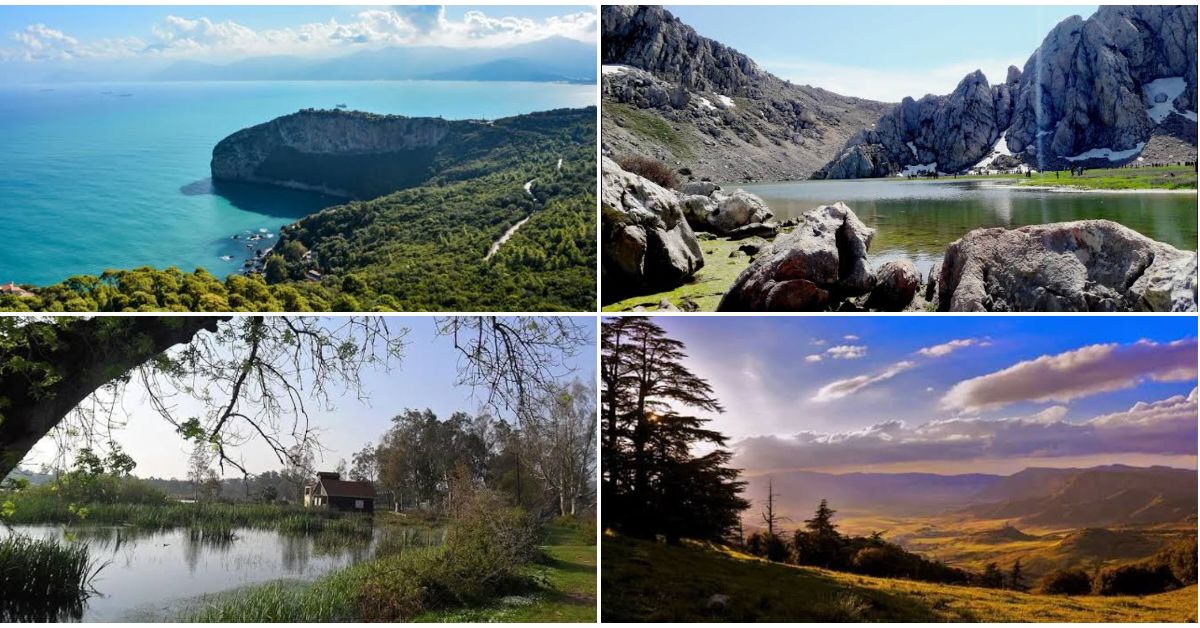
Belezma National Park
Located in the wilaya of Batna, in the northeast of the country, Belezma National Park is home to Mount Belezma, an imposing massif with rugged terrain, narrow valleys, and peaks exceeding 2,130 meters (djebel Tichaou) and 2,178 meters (djebel Refaâ).
Established in 1984, Belezma National Park, like Gouraya National Park in Béjaia and Taza National Park in Jijel, was created due to the presence of vast expanses of Atlas cedar trees, its rich archaeological and historical heritage, and its diversity of wet ecosystems in the north-northeast.
Located east of Northern Algeria, Belezma National Park covers 26,250 hectares and represents an elongated territory, oriented southwest/northeast, near Batna. UNESCO designated the park as a biosphere reserve in June 2015, covering an area of 262.50 km².
Chréa National Park
Located 50 km south of Algiers, in the wilaya of Blida, Chréa National Park is predominantly mountainous, in the heart of the Blida massif. In addition to its ski resort in Chréa, it houses vast cedar forests, as well as the Chiffa gorges and the Dhaya lake at Tamesguida. The park also offers hiking opportunities.
In terms of fauna, the cedar forests are home to a threatened population of Barbary macaques, while plant species include the Atlas cedar, evergreen oak, cork oak, thuja, Aleppo pine, holly, yew, and barberry. A variety of animals, including the Barbary macaque, Genet, Lynx, Striped Hyena, Mongoose, Porcupine, Golden Jackal, Fox, Wild Boar, Otter, and Weasel, as well as birds such as the Golden Eagle, Bonelli’s Eagle, Peregrine Falcon, Griffon Vulture, and Egyptian Vulture, inhabit the region. UNESCO recognized the park as a biosphere reserve in 2002.
El-Kala National Park
Located near the town of El Kala, in the wilaya of El-Tarf, in northeastern Algeria, El-Kala National Park was established in 1983, bordering the Mediterranean Sea to the north and the Tunisian border to the east.
The park includes numerous lakes and houses a unique ecosystem in the Mediterranean basin. It was classified as a biosphere reserve by UNESCO in 1990. Covering an area of 80,000 hectares, it encompasses several lakes and marshes, part of the Kroumirie mountain range and comprising eight bordering municipalities.
The central area of the park houses three lakes classified as internationally important wetlands according to the Ramsar Convention of UNESCO in 1983: Lake El Melah, Lake Oubeira, and Lake Tonga.
Djurdjura National Park
Located in the wilaya of Bouira, in Kabylie, in northern Algeria, Djurdjura National Park is home to vast forests, gorges, and caves, hosting a highly diverse fauna. It has been a UNESCO biosphere reserve since 1997.
The main trees in the region are the Atlas cedar, evergreen oak, cork oak, holly, field maple, Montpellier maple, common maple, wild cherry, zéen oak, black pine, Aleppo pine, and yew. Mammals present in the park include the Barbary macaque, Cape Hare, Wild Boar, Striped Hyena, Mongoose, African Golden Wolf, Egyptian Wolf, Barbary Leopard, Serval, Genet, Porcupine, and Weasel.
In terms of birds, there are the Golden Eagle, Griffon Vulture, Bearded Vulture, Egyptian Vulture, Bonelli’s Eagle, Kestrel, Buzzard, Tawny Owl, Eurasian Eagle-Owl, Song Thrush, Nightingale, Crossbill, Mistle Thrush, Green Woodpecker, and Hoopoe.
Gouraya National Park
Receiving around 1,200,000 visitors per year, mainly in summer, Gouraya National Park is renowned for its sandy beaches, cliffs, and clear waters. Mount Gouraya, reaching a height of 660 meters, dominates the park. The flora and fauna are diverse, with the presence of the Barbary macaque and the golden jackal living in isolated forests. The park was classified as a biosphere reserve by UNESCO in 2004.
Located on the eastern coast of Kabylie, in the wilaya of Béjaia, Gouraya National Park has endemic plant diversity, marine and terrestrial ecosystems, as well as a notable regional history. Occupying the entire municipality of Béjaia, it covers an area of 2,080 hectares, with a marine area of 7,842 hectares and a lake, Lake Mézaia, covering an area of 3 hectares. The park boasts a rich archaeological heritage, including 15 historical sites and 9 picturesque sites.
In terms of biodiversity, the park consists of 1,709 species, including 533 for flora and 1,156 for fauna, 67 of which are protected species, including 20 invertebrates, 1 reptile, 10 mammals, 3 plants, and 33 birds.
The marine area includes 173 zooplankton species, 164 zoobenthic species, 211 fish species, 5 mammal species, 55 phytoplankton species, and 72 phytobenthic species, 8 of which are considered “remarkable” according to the Red List.
Read the original article(French) on Algerie 360