Rédaction Africa Links 24 with Yousra Rhardoud
Published on 2024-03-26 16:34:00
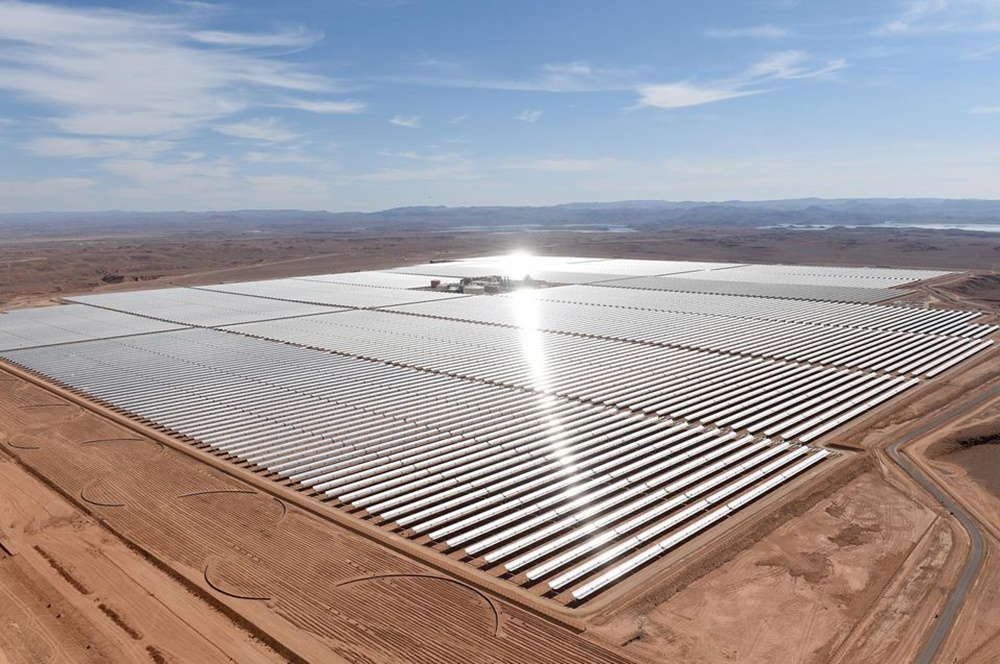
The Noor III solar power plant, a jewel of the Ouarzazate region in Morocco, recently faced a worrying situation, forced to shut down due to a leak detected in its molten salt tank. This decision, announced by the company Acwa Power, responsible for operating the plant, is a blow to the renewable energy sector, especially in the region.
In an official statement, Acwa Power described this incident as a “major technical failure”, highlighting the significant financial consequences that could amount to up to $47 million. This unexpected interruption of Noor III’s operations highlights the challenges faced by large-scale energy infrastructure, raising crucial questions about the reliability and safety of solar installations.
Regarding this, Amin Bennouna, an energy expert, explained that “The leak detected in the molten salt tank of Noor III presents a major challenge. With a tank the size of a three-story building, repairing the leak requires a complex and time-consuming process. The tank must be emptied, repaired, and then refilled, which takes several months. This highlights the challenges of maintaining large-scale solar installations.”
Noor Ouarzazate III stands out for its innovative central tower technology with molten salt storage, a design developed by the Sener Group. This promising technology aimed to optimize thermodynamic efficiency and solar energy management to meet the needs of the electrical grid, even during periods without sunlight. However, this incident highlights the potential vulnerabilities of these systems, despite their sophistication.
The shutdown of Noor III due to supply interruptions does not pose a major threat to Morocco’s electricity supply. The production from other Noor plants and other energy sources is sufficient to cover the deficit.
Our interviewee emphasizes that “Noor III, as part of the entire Noor Ouarzazate complex, represents a capacity of 580 megawatts. Detailing the complex, including Noor I, II, III, and IV, the tower plant of Noor Ouarzazate, which is Noor III, contributes 150 megawatts out of a total capacity of 680 megawatts.”
“In terms of annual production, the entire Noor Ouarzazate complex produces around 1800 gigawatt-hours per year, with the tower plant alone representing about 30% of this production, approximately 480 gigawatt-hours per year. In comparison, Morocco’s total electricity production amounts to around 42,000 gigawatt-hours per year, meaning that Noor III’s contribution is barely 1.5% of the country’s total electricity production. Therefore, panicking due to the shutdown of Noor III due to supply interruptions seems unjustified.” adds expert Bennouna.
The Noor solar complex in Morocco uses concentrating solar power technology, which allows energy to be stored as heat in molten salt. This technology has the advantage of being able to store large amounts of energy over long periods, making it an interesting solution for large-scale storage.
However, it is important to note that molten salt storage does not directly store electricity, but rather heat. This heat is then used to produce steam, which powers a turbine and generates electricity. This process involves energy losses, meaning that the overall system efficiency is lower than other storage technologies.
“Distribution authorities are not favorable to managing variable energy sources such as solar or wind. It is simpler for them to manage production when it is stored. Of course, I simplify by saying ‘when you want it’, but the idea is to be able to produce electricity and store it for later use. This issue related to Noor has sparked discussions because the chosen technology, concentrating solar power, is less common but allows for storage. If these actors truly want storage, why have they not activated the pumped-storage energy station (STEP)? In short, there are other ways to store electricity than molten salt storage because the latter does not store electricity but heat.” remarks Amin Bennouna.
The forced shutdown of Noor III raises legitimate concerns about the safety and reliability of large-scale solar installations, but it also offers an opportunity to reassess technological approaches and risk management strategies. As the world strives to transition to an economy based on cleaner and renewable energies, it is imperative to invest in research and development to ensure the sustainability and resilience of future energy infrastructure.
The resumption of Noor III’s activities is eagerly awaited, not only for its contribution to the energy transition and carbon emission reduction but also for its crucial role in regional economic development. However, it is essential that this resumption be accompanied by rigorous measures aimed at strengthening the reliability and safety of solar installations, while stimulating innovation and promoting a more resilient and sustainable energy transition.
Read the original article(French) on L’Opinion